

line of longitude
- noun
- /laɪn əv ˈlɒndʒɪtud/
- Specialized
- The explorer documented the line of longitude at which he landed on the remote island.
Examples
-
Greenwich is famous for being the standard zero line of longitude in geographical measurements.
-
The line of longitude runs from the North Pole to the South Pole.
-
Each city lies on a different line of longitude and therefore has a different local time.
-
Can you find the line of longitude on the map?
-
The line of longitude at 30 degrees east runs through several countries in Africa.
-
To find your exact location, you need to know your line of longitude and line of latitude.
-
The line of longitude helps mapmakers to create accurate representations of the Earth.
Synonyms

 3
6.7
3
6.7

An imaginary line from the North Pole to the South Pole that shows position east or west
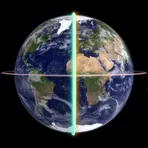
An imaginary line on Earth's surface joining the North and South Poles that shows longitude
Surface Forms
Morphology
The meaning is directly compositional: 'line' (a conceptual division or mark) combined with 'longitude' (measurement of east–west position) yields the imaginary line representing a particular longitude. This standard noun-of-noun composition is cross-linguistically common and should be inferable by a B1 learner who knows both constituents.
Etymology
The noun line of longitude comes from the idea of an imaginary line running from the North Pole to the South Pole on a globe, like the lines on an orange. These lines, and the word longitude, show a place's 'location' east or west and help set local time, so a line of longitude means the north–south line we use to find where something is and what time it is there.