

lindy hop
 2
7.9
2
7.9

- noun
- /ˈlɪndi hɑp/
- Tonight's class will begin with a review of the lindy hop.
Examples
-
Tonight's class will begin with a review of the lindy hop.
-
When it looked like it couldn't get any better, a young dancer named Frankie "Musclehead" Manning created the first air steps, and the lindy hop soared.
-
In Harlem, the lindy hop was breaking out wherever people were dancing.
-
Would you like to assist me in a brief demonstration of the lindy hop before we move on to the cha-cha-cha?
-
The lindy hop got hotter and hotter as the people danced to the top big bands in the land.
-
But it wasn't until the opening of the Savoy Ballroom that the lindy hop got its home.
-
The lindy hop was so named after Charles Lindbergh's flight to Paris in 1927, when the newspaper headlines read, "Lindy Hops the Atlantic."
-
The lindy hop got its name in 1927, after Charles Lindbergh's flight to Paris when the newspapers proclaimed, "Lindy Hops the Atlantic."
-
In Harlem, the lindy hop was breaking out wherever people were dancing.
-
Would you like to assist me in a brief demonstration of the lindy hop before we move on to the cha-cha-cha?
Synonyms
 2
9.7
2
9.7
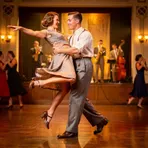
An energetic American swing dance from the 1930s with fast turns and lifts
How Energetic
1
4.2
 2
7.9
7
7.6
107
1.8
60
4.8
1
7.4
44
3.2
2
7.9
7
7.6
107
1.8
60
4.8
1
7.4
44
3.2
Surface Forms
Morphology
The noun 'hop' clearly signals a dance or dance event and 'lindy' functions as a style/name modifier, so the compound denotes a type of dance; a learner who knows both constituent meanings can infer it refers to an energetic dance. While historical and stylistic specifics (jazz/swing origin, 1920s–30s) are not predictable from the words alone, the basic sense 'a lively dance' is directly derivable from the parts.
Etymology
Lindy hop comes from the 1920s American dance scene. One popular story says dancers named the move after pilot Charles Lindbergh, calling it Lindy, and added hop because the dance has quick jumps and lively steps. That's why Lindy hop means 'an energetic partner dance' with fast, playful moves.