
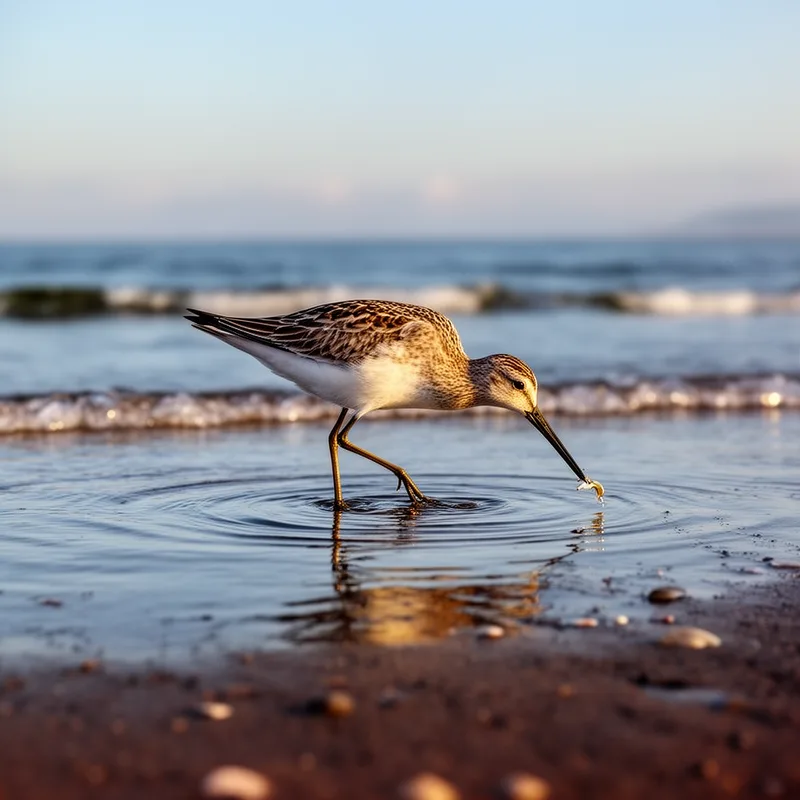
limicoline bird
- noun
- /ˌlɪmɪˈkoʊlaɪn bɜrd/
- Specialized
- The estuary provides a vital habitat for several species of limicoline birds.
Examples
-
Researchers observed a variety of limicoline birds probing the mudflats for insects.
-
Many limicoline birds migrate thousands of miles each year to breed along northern seashores.
-
The limicoline bird searched for food along the shore.
-
Many limicoline birds migrate during the winter months.
-
Researchers observed a variety of limicoline birds probing the mudflats for insects.
-
Many limicoline birds migrate thousands of miles each year to breed along northern seashores.
-
The estuary provides a vital habitat for several species of limicoline birds.
Synonyms

 3
3.7
3
3.7

A bird that lives by the sea and searches mud or sand for food
 1
4.0
1
4.0
A bird that walks in shallow water to feed on beaches and river mouths
 1
3.6
1
3.6
A bird with long legs that stands in shallow water to catch fish and insects
Surface Forms
Morphology
limicoline + bird
The noun phrase is a straightforward adjective + noun composition: if a learner knows 'limicoline' (meaning relating to waders/mud-dwelling) and 'bird', the combined meaning 'a wading bird' is directly derivable. Although 'limicoline' is rare and technical so a typical B1 learner may not know that adjective, the structure itself is fully compositional and transparent if the constituents are known.
Etymology
The noun limicoline bird comes from parts that mean limi- 'mud' and -coline 'living in', so it literally means a 'mud-dwelling' bird. That's why the term is used for wading birds that probe mud flats and seashores for food.