

limber pine


 1
8.6
1
8.6
- noun
- /ˈlɪmbər paɪn/
- Specialized
- She ran a finger over the sharp blade and started for the stand of limber pine on the slope above her.
- fir and limber pine
Examples
-
But our mountain is like much of the West—mature lodgepole and ponderosa mixed with limber pine, much of it dead or dying from pine beetles.
Blog text (16) -
The inner bark of the limber pine could be chewed.
Fiction book (1992) -
Well, for example, if the rice grass is burned in a range fire, the people know where to go for limber-pine nuts.
Fiction book (1992) -
Farther along, I see broken branches around my biggest limber pine.
Fiction book (2001) -
They fought over who could collect from the root grounds, or harvest from the limber pine, or gather the grass seeds.
Fiction book (1992) -
He'd broken off a branch of limber pine and brushed away the tracks, then gotten rid of the scat.
Fiction book (1998) -
Higher on the hills to the south, limber pine and juniper dotted the slopes, mixing with scattered sage and occasional bitterbrush.
Fiction book (1992) -
He tethered the horses in the shade of a stand of limber pine and led the anthropologist up through the stiff-branched mountain mahogany to the overhang.
Fiction book (1997) -
While hiking in the Rockies, I discovered a grove of ancient limber pines with their unique, flexible branches.
-
The campsite was nestled next to a tall limber pine, providing shade and a scenic view of the surrounding mountains.
Synonyms
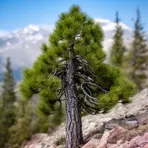
A pine tree with long needles, very flexible branches, and dark grey furrowed bark that grows in western North America
Surface Forms
Morphology
The noun phrase is fully compositional: 'limber' (able to bend) describes the 'pine' (a tree), so the meaning 'a pine tree with flexible branches' is directly derivable from the constituents. This adjective+noun pattern is a common, cross-linguistic way to form descriptive plant names, so a B1 learner who knows both words would readily understand it.
Etymology
Limber pine comes from the word limber, meaning 'bending easily'. Its long branches bend under heavy snow and strong wind without breaking, so people called this mountain tree 'limber' and the name stuck.