

lily turf
- noun
- /ˈlɪli tɜrf/
- The lily turf thrived in the shady areas of the garden where grass wouldn't grow.
Examples
-
Clusters of purple flowers appeared on the lily turf in late summer, adding color to the landscape.
-
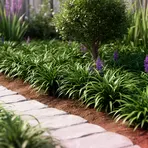
We planted lily turf along the pathway to create a neat, green border.
-
The garden was filled with lily turf.
-
Many homeowners choose lily turfs for their gardens.
-
In my garden, I planted lily turf to provide a lush ground cover beneath the trees.
-
The lily turf flourished in the shade and added a pop of color with its purple flowers.
-
We decided to use lily turf along the pathway for its beautiful evergreen leaves and low maintenance.
Synonyms


 1
9.9
1
9.9
A low grass-like plant that people use to cover ground in gardens
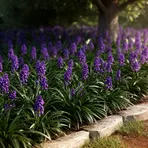
A low evergreen plant with grasslike leaves and purple flower clusters that covers the ground

A small evergreen plant with leaves like grass and purple flower clusters used as ground cover
Surface Forms
Morphology
The combination 'lily' + 'turf' signals a plant related to lilies and used as turf/groundcover, so a B1 learner who knows both words could reasonably guess it is a low-growing ornamental plant used to cover the ground. However, the precise botanical identity and specific features (genus Liriope, grasslike leaves and grapelike flowers) are not derivable from the parts alone, making the relation only partially predictable.
Etymology
Lily turf gets its name from the plant's look: it has small, lily-like flowers and long, grass-like leaves that form a low green carpet. Gardeners used the words lily (for the flowers) and turf (for the carpet), so the name came to mean a plant used as 'ground cover'.