
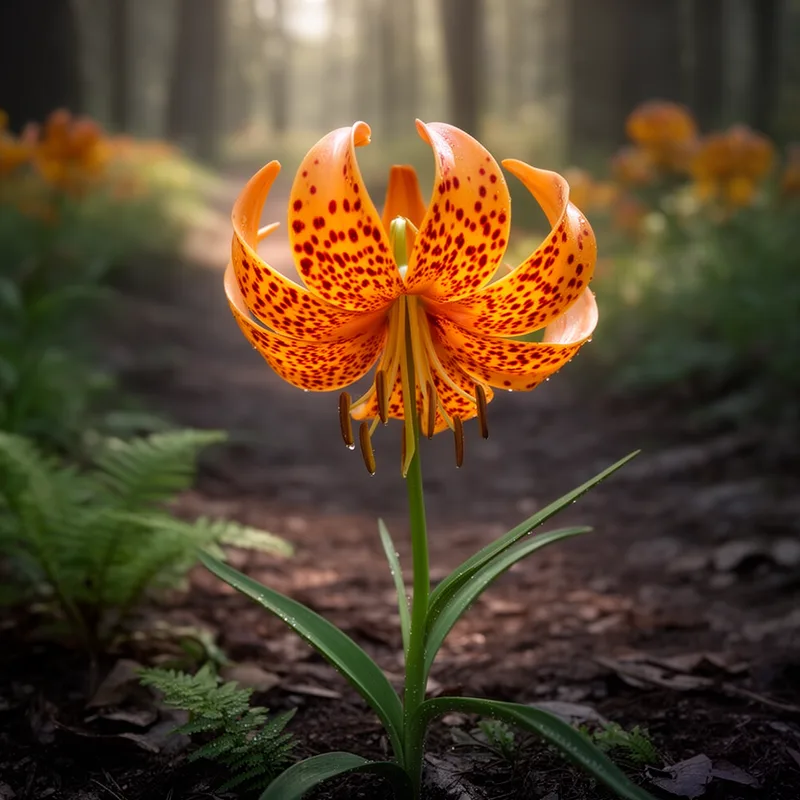
leopard lily
- noun
- US
- Gardeners often plant the leopard lily for its vibrant, spotted petals and unique appearance.
Examples
-
The leopard lily thrives in moist, well-drained soil and partial sunlight.
-
We admired the striking blooms of the leopard lily along the woodland trail.
-
The leopard lily blooms beautifully in the summer.
-
Have you seen the leopard lilies in the garden?
-
Gardeners often plant the leopard lily for its vibrant, spotted petals and unique appearance.
-
The leopard lily thrives in moist, well-drained soil and partial sunlight.
-
We admired the striking blooms of the leopard lily along the woodland trail.
Synonyms

A tall lily with orange-red flowers that have dark red spots

A plant with orange-red flowers and maroon spots that grows in the western United States

A type of lily with bright orange flowers with purple spots from western North America

A tall orange-red flower with purple spots that grows wild in western North America
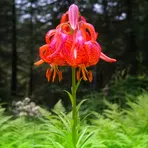
A tall wild flower from western North America with bright orange-red flowers spotted with purple

A lily from central North America with orange red curved petals and dark red spots

A tall flowering plant from central North America with orange-red curved-back petals marked with dark red spots
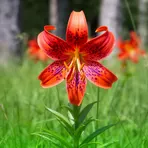
A wild lily from eastern North America with orange or red flowers spotted purple
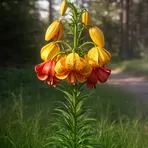
A tall wildflower with nodding yellow or reddish flowers spotted with brown

A wild lily from the eastern United States with hanging yellow or reddish spotted flowers

A common wild flower with nodding yellow or red petals spotted with brown
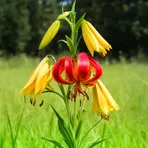
A wild flower that grows in meadows and open woods and has hanging yellow or red blooms with brown spots
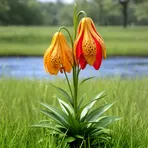
A plant from eastern North America with hanging yellow or red flowers spotted with brown
Surface Forms
Morphology
The meaning 'a lily with spotted, colorful flowers' is directly inferable from combining 'leopard' (an animal with spots) and 'lily' (a flowering plant); the compound transparently describes a lily that looks like a leopard. This noun–noun compounding pattern (animal/adjective + plant) is cross-linguistically common and follows standard English composition, so a B1 learner who knows both constituents will understand it.
Etymology
Leopard lily comes from the flower's spotted petals: the dark spots on the orange or yellow petals looked like a leopard's spots, so people began to call the plant a leopard lily.

