
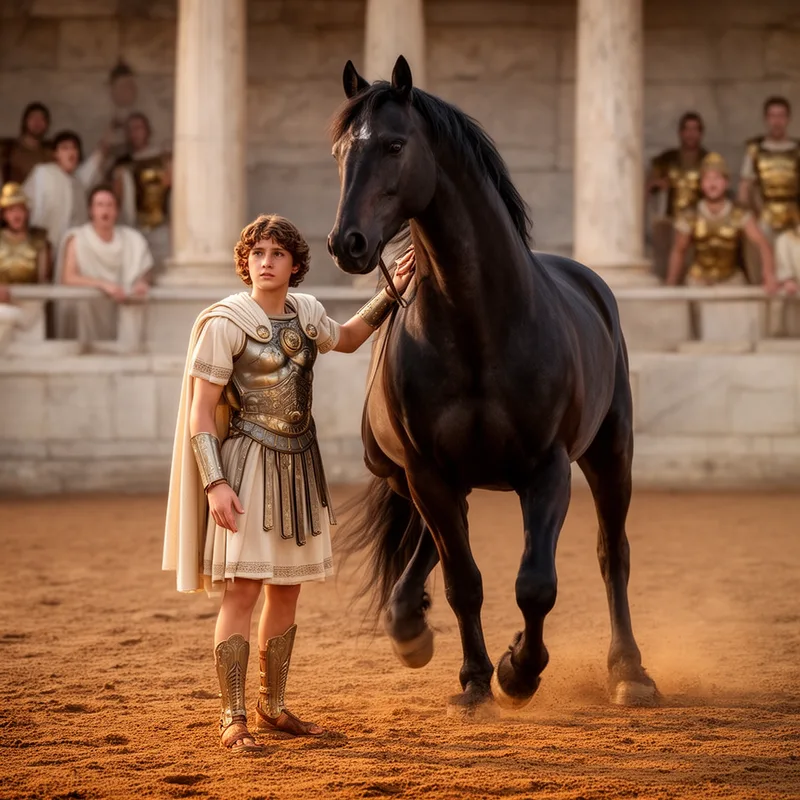
legend of Bucephalus
- noun
- Literature
 :
leyenda de Bucephalus
:
leyenda de Bucephalus
- The legend of Bucephalus tells of a horse that was tamed by Alexander.
Examples
-
The legend of Bucephalus is told to illustrate Alexander's extraordinary skill and determination.
-
Historians often recount the legend of Bucephalus when discussing figures of ancient Greece.
-
Many young riders are fascinated by the legend of Bucephalus and dream of such a bond with their own horses.
-
Have you heard the legend of Bucephalus?
-
Many young riders are fascinated by the legend of Bucephalus and dream of forming a deep connection with their horses.
-
Historians often recount the legend of Bucephalus to highlight the strong bond between Alexander the Great and his horse.
-
The legend of Bucephalus showcases the remarkable loyalty and bravery of a horse who served Alexander the Great.
Synonyms

 2
9.9
2
9.9

A long Latin poem by Virgil that tells the journey of Aeneas from Troy to the founding of Rome
 1
9.5
1
9.5
Stories and myths about King Arthur and his knights at Camelot
Surface Forms
Morphology
legend + of + Bucephalus
The meaning is directly compositional: 'legend' = traditional story and 'of Bucephalus' specifies the story's subject, so a learner who knows both constituents can infer it is the traditional story about Bucephalus. The noun + of + proper-name pattern is common across languages, making the relation immediately predictable for B1 learners.
Etymology
Legend of Bucephalus comes from a famous story about Alexander and a wild horse: the horse feared its own shadow, so Alexander turned it toward the sun, calmed it and rode it, 'taming' the animal. That's why the Legend of Bucephalus is told to show 'great skill' and a strong, loyal bond between a rider and his horse.