

leaf-cutter
 1
7.3
1
7.3

- noun
- /ˈliːfˌkʌtər/
- These had once been leaf-cutter ants, content to slice up fodder for their own tribe.
- leaf-cutter ant
Examples
-
Another bee that looked promising in Cane's preliminary tests: a honey bee-sized leaf cutter called Megachile addenda.
Academic text (2000) -
For example, leaf cutter ants, who can strip a coffee plant to its bones.
Blog text (11) -
Attines include the destructive leaf-cutter ants of Central America.
Academic text (1995) -
Leaf-cutter colonies are divided into big ants, which tote the leaves home, and little ones.
Academic text (2000) -
Leaf-cutter ants dig nests the size of small rooms, which swarm with millions of morphologically specialized workers.
Academic text (1996) -
Leaf-cutter ants have grown entirely reliant on their farmed food, fungus that grows on the leaves they bring to their nest.
Academic text (2011) -
The parasitic flies that attack leaf cutters have a special approach to their hosts: they land on a leaf fragment carried by an ant and then crawl down to lay their eggs in the gap between the ant's head and thorax.
Academic text (2000) -
The best-known attine species is the leaf-cutter ant, in the genus Atta, which gathers small slices of leaves on which to grow fungi.
Academic text (1996) -
When newly hatched female leaf-cutters leave on a maiden flight, they take along a small dowry of fungus to use in starting a new colony, thus assuring a "vertical" transmission of fungi from colony to colony.
Academic text (1996) -
The leaf-cutter ants work tirelessly to gather pieces of leaves for their nest.
Synonyms
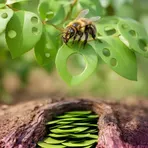
A bee that cuts pieces from leaves to make its nest

A bee that cuts small pieces from leaves or flowers to build its nest
Surface Forms
Morphology
Etymology
Leaf-cutter is made from leaf and cutter, so it literally means 'one who cuts leaves'. It refers to a bee that cuts pieces of leaves or flowers to line its nest, like a tiny gardener.