
lateralization
 1
8.8
1
8.8

- noun
- /ˌlætəˌrælɪˈzeɪʃən/
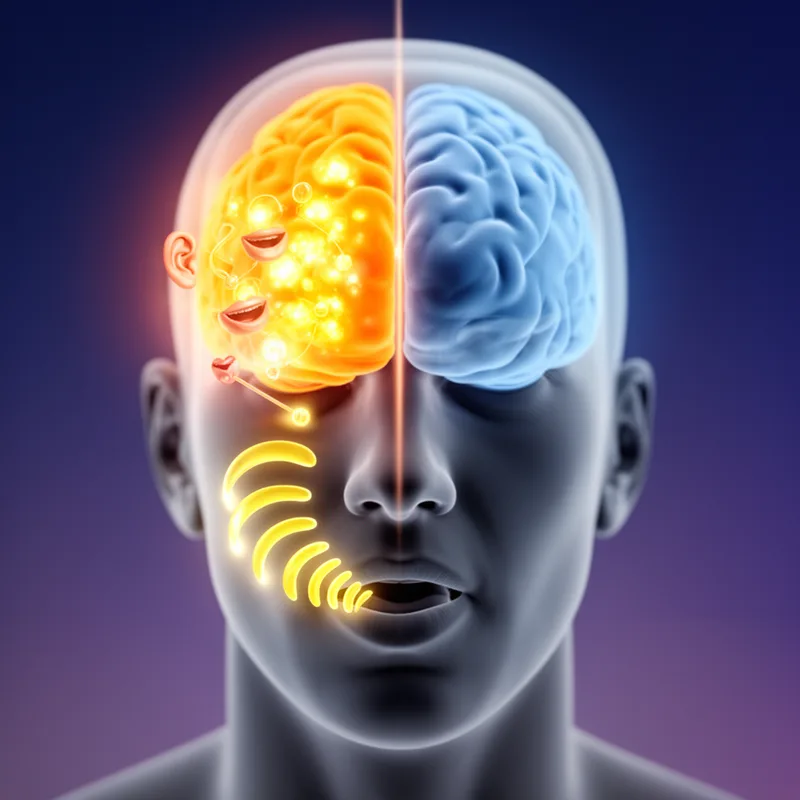
- Research on brain lateralization shows that language functions are primarily processed in the left hemisphere for most right-handed individuals.
- cerebral lateralization
- Brain lateralization
Loading YouTube…
Watch on YouTubeAnytime I hear about lateralization of function, I get particularly curious because obviously we have two mirror symmetric sides of the brain.
- Anytime I hear about lateralization of function, I get particularly curious because obviously we have two mirror symmetric sides of the brain.
Examples
-
Although the lateralized headphone sensation is quite different from the sensation of a localized source, experiments show that lateralization is intimately connected to localization.
Academic text (1999) -
Lenneberg (1967), who further developed the critical period hypothesis, believed that the lateralization of language functions in the left hemisphere is considered to be completed by puberty.
Academic text (2001) -
Anytime I hear about lateralization of function, I get particularly curious because obviously we have two mirror symmetric sides of the brain.
-
The effect can also be measured as an increased variance in lateralization judgments.
Academic text (1999) -
If there is a brain asymmetry or a lack of dominant lateralization (mixed dominance), academic progress may become arrested.
Academic text (2000) -
Such an assumption is based on the critical period hypothesis, which states that children have a natural ability to acquire a new language before cerebral lateralization at about puberty or age twelve.
Academic text (2005) -
Researchers have adapted adult research that investigated cerebral lateralization (usage of the left and right hemispheres of the brain) for processing musical contour, and now report that this brain specialization is present at a very early age.
Academic text (2000) -
The study confirmed the lateralization of motor functions, revealing how the right side of the brain controls movements on the left side of the body.
-
Doctors often examine brain lateralization to understand how different hemispheres contribute to cognitive abilities and emotional processing.
Synonyms
 1
6.6
1
6.6
The idea that certain tasks happen in specific small parts of the brain or body

How much one side of the brain is more active than the other

A natural preference for one side of the body, like being right- or left-handed
How Lateralized

Surface Forms
Morphology
lateralization = lateralize (transparent) = lateral + ize + ation
The noun is formed regularly from the verb 'lateralize' with '-ation', producing a predictable nominalization.
Etymology
The word lateralization comes from a Latin word latus, which means 'side', and you can see the same idea in bilateral, which means 'two sides'. So lateralization is when a skill or function is mainly on one 'side' of the brain, such as language often being on the left side.