

lateral line organ
- noun
- /ˈlætərəl laɪn ˈɔrgən/
- Specialized
- Many aquatic creatures rely on their lateral line organ to sense vibrations and avoid predators.
Examples
-
The fish uses its lateral line organ to sense movement.
-
Researchers studied the lateral line organ to better understand how fish detect currents in the water.
-
Damage to the lateral line organ can affect a fish’s ability to navigate its environment.
-
Many species of fish have a lateral line organ.
-
Many aquatic creatures rely on their lateral line organ to sense vibrations and avoid predators.
-
Damage to the lateral line organ can affect a fish’s ability to navigate its environment.
-
Researchers studied the lateral line organ to better understand how fish detect currents in the water.
Synonyms
 1
8.3
1
8.3

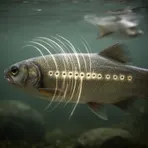
A line of small sense organs along the side of a fish or amphibian that senses water movement
Surface Forms
Morphology
The components 'lateral' (side), 'line' (a linear feature) and 'organ' (a body part) allow a learner to infer an organ that runs along the side of an animal, so the locational/structural sense is fairly transparent. However, the precise biological function (a sensory system detecting water pressure and movement) is technical and not directly predictable from the constituents, making the term partially but not fully transparent to a B1 learner.
Etymology
Lateral line organ gets its name from the long row of tiny sense cells along a fish's side: lateral means 'side', line means 'a row', and organ means 'a body part'. This row works like a set of water sensors, so fish use the lateral line organ to feel nearby movement and currents.