
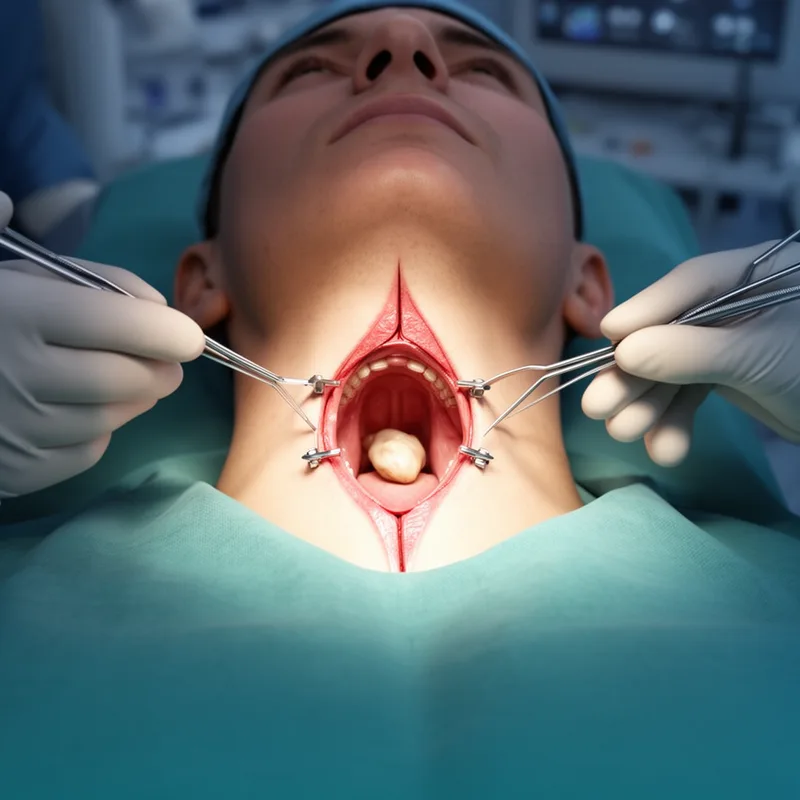
laryngofissure
- noun
- /ˌlɛrɪŋɡoʊˈfɪʃər/
- Specialized
- During the operation for laryngeal cancer, the surgeon performed a laryngofissure to access the affected area more effectively.
Examples
-
Endoscopic procedures are best suited for small endolaryngeal lesions; the more aggressive laryngofissure approach is used for recurrences and for lesions that have spread beyond the confines of the larynx.
Academic text (2009) -
The treatment of choice for an oncocytic lesion is complete endoscopic excision or, if necessary, laryngofissure. A partial laryngectomy is occasionally required.
Academic text (2009) -
Therefore, a decision to undertake definitive surgical treatment was made, and laryngofissure was performed.
Academic text (1996) -
Excision can be performed endoscopically or by the laryngofissure procedure described by Watanabe et al. in 1984.
Academic text (2004) -
They range from the minimally invasive endoscopic needle aspiration to more involved procedures such as marsupialization, extended ventriculotomy, and the open laryngofissure approach.
Academic text (2009) -
An external approach is indicated for larger tumors—either a lateral pharyngotomy, lateral thyrotomy, or a laryngofissure technique.
Academic text (2005) -
Laryngofissure with keel or stent placement may be performed for more severe obstructions; it allows for simultaneous treatment of subglottic stenosis and cartilage grafting.
Academic text (2009) -
The laryngofissure procedure allowed the doctor to retrieve a foreign object lodged in the patient's throat.
-
In cases of severe laryngeal obstruction, a laryngofissure may be necessary to restore the patient's ability to breathe.
Surface Forms
Morphology
Etymology
Laryngofissure comes from the parts laryngo-, from larynx meaning 'voice box', and fissure, meaning 'split' or 'crack'. That's why it can mean a surgical cut that opens the voice box on purpose so doctors can reach inside.

