
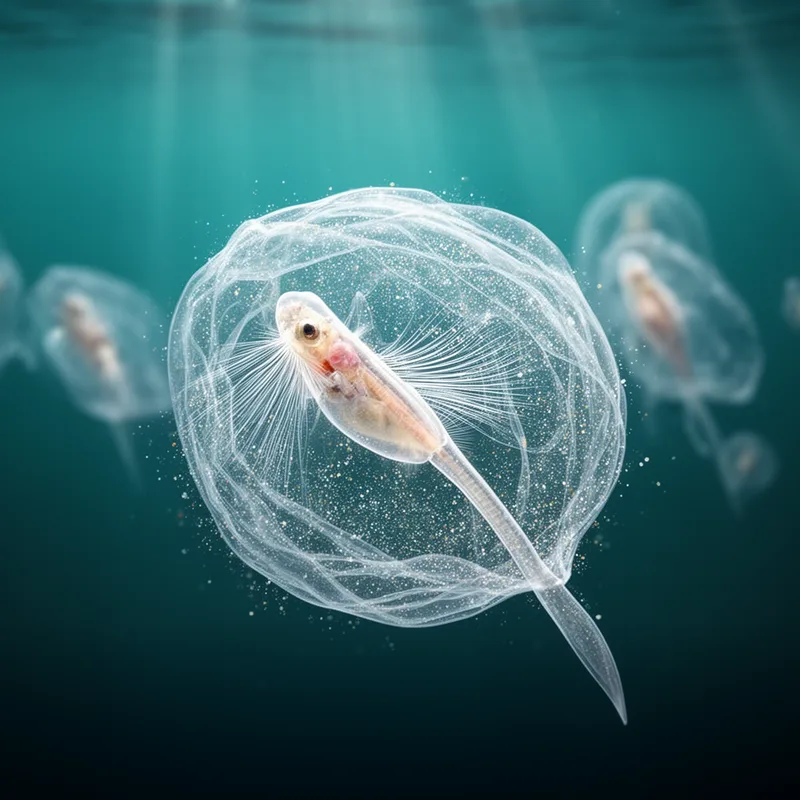
larvacean
- noun
- /ˌlɑːrˈveɪʃən/
- Specialized
- Each larvacean retains features from its larval stage, which makes it different from most adult marine animals.
- giant larvaceans
Loading YouTube…
Watch on YouTubeHere is how the giant larvacean one UPS the hagfish.
- Here is how the giant larvacean one UPS the hagfish.
Examples
-
Giant larvaceans are hermaphroditic; male and female gametes are released when the trunk ruptures.
Academic text (2004) -
The side view (top) of one larvacean shows its trunk (tr) and tail.
Academic text (2004) -
Here is how the giant larvacean one UPS the hagfish.
-
What, the researchers wondered, were giant larvaceans doing down this deep?
Academic text (2004) -
The front view (bottom) of another larvacean shows an opaque gonad (g) just beginning to form on either side of the trunk.
Academic text (2004) -
The larvacean uses its unique filter-feeding structure to capture tiny particles from the water.
-
Scientists discovered a new species of larvacean during their research in the deep ocean.
Synonyms
A small free-swimming sea animal with a transparent body that filters food from seawater

A small tadpole-shaped sea animal that swims freely and filters food from water
Surface Forms
Morphology
larvacean = Larvacea (semi-transparent) = larvacea + an
Formed from the taxonomic name 'Larvacea' plus the adjectival/nationality-like suffix '-acean'; the structure is regular but the term is specialized and not obvious to general learners.
Etymology
Larvacean comes from larva ('young form' or 'baby') plus the group ending -acean, so the name points to a sea animal that keeps its 'baby' shape as an adult, which is why larvaceans look like permanent larvae.

