

lanyard
- noun
- /ˈlæn.jərd/
- Archaic
- When he was on target, the gun captain either applied a slow match to the touch hole or, as seen here, pulled a lanyard attached to a gun lock to fire the gun.
Examples
-
The gun captain pulled the lanyard attached to the cannon to take the shot.
-
He yanked the lanyard to fire the cannon during the demonstration.
-
That same man yanked on the lanyard and fired the piece.
Fiction book (1992) -
Still another attached primer and lanyard.
Fiction book (1992) -
Because you're pulling a lanyard waiting for the all clear saying, you know, you hit the target or you know, adjust, which means oops.
-
A spar torpedo was a warhead on the end of a twenty-foot pole, which was to be extended out in front of the boat that carried it, to be detonated next to the target ship by pulling a lanyard.
Blog text (26) -
With bullets whipping all around him, Cushing yanked the lanyard on the torpedo, and the Albemarle sunk at her mooring.
Blog text (26) -
To fire the weapon, the soldier had to pull the lanyard firmly.
Synonyms
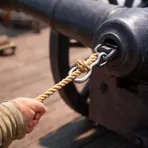
A cord with a hook used to pull and fire a cannon
Surface Forms
Etymology
Lanyard comes from an old French word lanière meaning 'strap' and from Latin linea meaning 'line'. In older weapons a 'line' was used to fire a gun from a safe distance, so a lanyard became the cord you pull to fire a cannon.

