
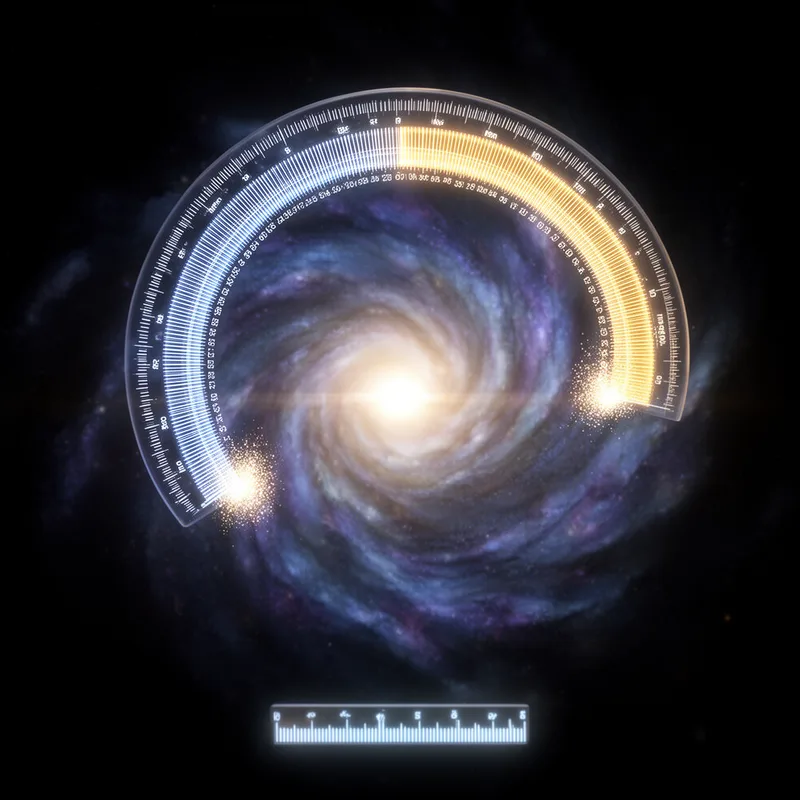
kpc


 1
9.9
- noun
- Specialized
- Figure 4 shows the scattered pulse from a distant pulsar viewed through a distance of more than 10 kpc in the Galactic plane.
- about 1 kpc
Examples
-
In the near IR, at a wavelength near 2 microns, this requirement is relaxed to distances of 5 to 10 kpc.
Academic text (1999) -
Do you come from a spherical halo around our own galaxy (100 kpc, about 300,000 light-years)?
Academic text (1996) -
In the optical band, Tau < 1 corresponds to distances less than about 1 kpc when looking in the plane of the Galaxy.
Academic text (1999) -
P.S.: No, Paul, while I did get the email, I’m too busy taking care of an elder human to write much or do so consistently; though I did OK in college-level courses at UAA and KPC, thanks though.
Blog text (12) -
The nearest galaxy to us is about 0.78 kpc away.
-
Scientists estimate that the supermassive black hole is located around 8 kpc from the center of our galaxy.
-
Astronomers often measure the distance to nebulae in kpc for better understanding of cosmic scales.
Synonyms
 1
9.9
A way to measure very large distances in space equal to about 3,260 light years
Surface Forms
Etymology
Kpc stands for kiloparsec: kilo- means 'one thousand', just like in kilometre, and a parsec is an astronomy distance of about three light-years. So a kpc is about one thousand parsecs and is a handy way to talk about the very large distances between stars and galaxies.