

knee-jerk reflex


 1
3.9
1
3.9
- noun
- /niː dʒɜrk ˈriːflɛks/
- Specialized
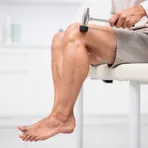
- The doctor tested my knee-jerk reflex by tapping just below my kneecap.
Examples
-
The doctor tested my knee-jerk reflex with a small hammer.
-
A strong knee-jerk reflex can indicate a healthy nervous system.
-
Children often find it amusing to watch their knee-jerk reflex in action during checkups.
-
Loss of the knee-jerk reflex can be a sign of nerve damage.
-
The doctor demonstrated the knee-jerk reflex by striking the patient's knee with a small hammer.
-
When the doctor tapped his knee, the knee-jerk reflex caused his leg to kick out automatically.
-
She was surprised by her strong knee-jerk reflex when the doctor tested her response during the check-up.
Synonyms
 3
4.3
3
4.3
Lower leg suddenly kicks out when the area below the kneecap is tapped
 1
6.0
1
6.0
A quick kick of the lower leg after a tap below the kneecap

A muscle tightens when its tendon is stretched to help keep the body upright

An automatic muscle tightening that happens when a muscle is pulled
Surface Forms
Morphology
knee-jerk + reflex
The phrase is compositionally built: 'knee-jerk' describes a jerk of the knee and 'reflex' denotes an automatic bodily response, so the meaning of an automatic extension of the lower leg is directly derivable from the parts. While 'knee-jerk' can be used metaphorically in other contexts, in this physiological sense the structure is literal and cross-linguistically transparent, so a B1 learner who knows 'knee', 'jerk' and 'reflex' would readily understand it.
Etymology
Knee-jerk reflex comes from a simple test where a doctor taps just below the kneecap and the lower leg quickly jerks out. Because this knee-jerk action happens without thinking, the phrase describes a fast, 'automatic' reaction.