

kitul tree
- noun
- Indian
- The kitul tree is tapped for its sweet sap, which villagers turn into jaggery.
Examples
-
In certain parts of Sri Lanka, the kitul tree plays an important role in traditional agriculture.
-
Farmers harvest sago from the trunk of the kitul tree during the dry season.
-
The kitul tree is commonly found in Sri Lanka.
-
In India, the kitul tree is valued for its sap.
-
Farmers harvest sago from the trunk of the kitul tree during the dry season.
-
In certain parts of Sri Lanka, the kitul tree plays an important role in traditional agriculture.
-
The kitul tree is tapped for its sweet sap, which villagers turn into jaggery.
Synonyms
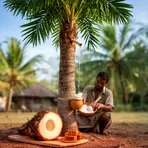
A palm tree with fishtail leaves grown for its sap and the soft inside of its trunk that is eaten

A tall palm tree whose sweet sap makes brown sugar and whose soft inner trunk gives sago
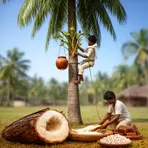
A palm tree whose sap is used to make brown sugar and whose trunk gives sago

A tall palm whose sweet sap makes jaggery and whose soft inner trunk gives sago
Surface Forms
Morphology
The phrase 'kitul tree' is a straightforward noun phrase naming a species: knowing 'kitul' (a particular kind of palm) and 'tree' lets a learner infer it refers to that tree species. There is no idiomatic or metaphorical shift, so the meaning is directly compositional and predictable from the constituents.
Etymology
Kitul tree is a palm people tap for sweet sap; villagers make small cuts in the trunk, collect the sap in pots and boil it into 'jaggery', and the trunk also gives sago. That's why the kitul tree is remembered as a tree used for sweet sugar and sago.

