

king salmon
- noun
- /kɪŋ ˈsælmən/
- US
- At the market, she bought a fillet of fresh king salmon for dinner.
Examples
-
Sushi chefs often prefer king salmon for its rich flavor and buttery texture.
-
The grilled king salmon was perfectly seasoned and flaky.
-
I love eating king salmon for dinner.
-
The king salmon is rich in omega-3 fatty acids.
-
At the market, she bought a fillet of fresh king salmon for dinner.
-
Sushi chefs often prefer king salmon for its rich flavor and buttery texture.
-
The grilled king salmon was perfectly seasoned and flaky.
Synonyms

 76
1.0
76
1.0

Pink meat from the fish that people cook and eat
 3
8.0
3
8.0
A large salmon from the Pacific Ocean often eaten as food

Pink or white flesh of a large Pacific fish that people eat

A large Pacific salmon called king salmon that people eat and that lays eggs and then dies
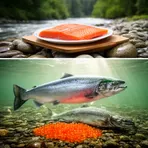
A large Pacific fish eaten for its rich meat that lays eggs and then dies
Surface Forms
Morphology
The phrase is a straightforward compound of 'king' (denoting the foremost/largest or best) and 'salmon' (the fish), so its meaning as a particular, large/valued type of salmon is directly inferable. This follows a common naming pattern (e.g., 'king crab', 'rock salmon') and would be understandable to a B1 learner who knows both constituents.
Etymology
The name king salmon also came to mean the fish's meat because cooks and sellers used the rich, fatty fillet from the prized king fish like special food for a 'king'. That's why 'king salmon' can mean the pink or white flesh we eat today.