
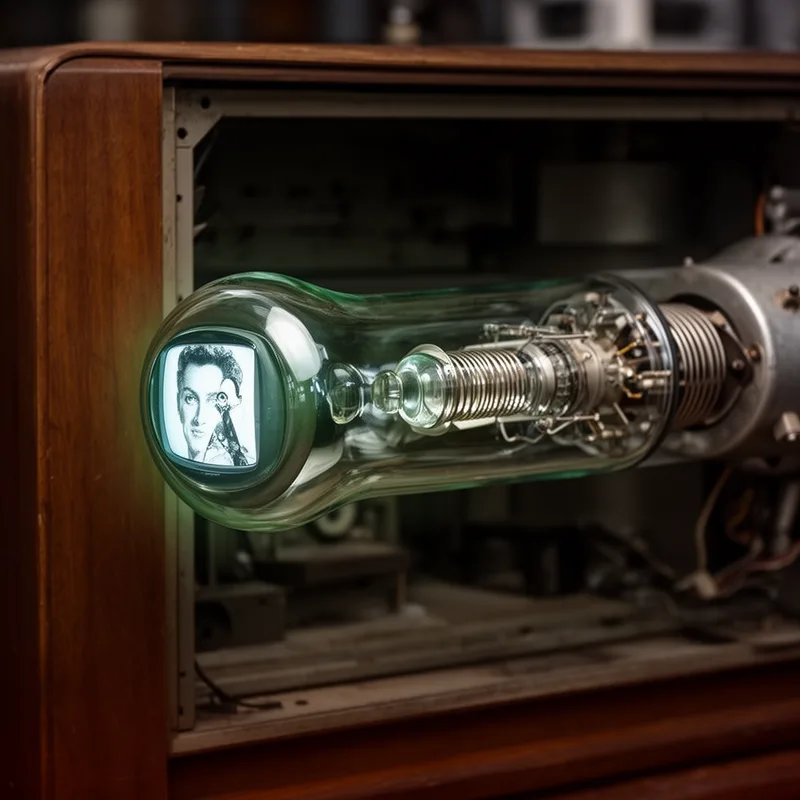
kinescope


 1
9.9
1
9.9
- noun
- /ˈkɪnɪˌskoʊp/
- Archaic
- And if there are any historians about 50 or 100 years from now... ...and there should be preserved... ...the kinescopes of one week of all three networks... ...they will there find recorded in black and white, and in color... ...evidence of decadence, escapism... ...and insulation from the realities of the world in which we live.
Examples
-
In the 1960s and early 1970s, when videotape and kinescope technology permitted, large numbers of United States programs on tape and film were imported as well.
Academic text (1991) -
In the early days of television, a kinescope was often used to record and display shows for viewers at home.
-
Many classic television programs were preserved as kinescopes, capturing the performances for future audiences.
-
Historians often study kinescopes from the 1950s to understand the culture and television history of that era.
Synonyms
 1
5.8
1
5.8
A long glass tube inside old televisions that makes the picture on the screen
 1
6.0
1
6.0
A large glass device in old TVs and computer screens that makes pictures with a beam of electrons
A glass tube inside old TVs that makes the picture on the screen

A heavy old TV or computer screen that uses a glass tube to show images
A large glass part inside old televisions that shows pictures in color
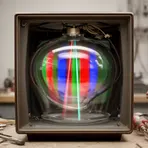
A glass bulb inside older televisions that makes the screen show color pictures

Part of a television that shows pictures in color
Surface Forms
Morphology
kinescope = kine + scope
The word is a neoclassical coinage built from classical combining forms meaning 'movement' and 'viewing instrument,' but the specific early-TV device sense is not guessable from the parts for most learners.
Etymology
Kinescope comes from Greek parts kinesis 'movement' and skopein 'to look', like you see in kinetic and telescope. So a kinescope is literally 'looking at movement', which fits the old TV tube that shows moving pictures.