
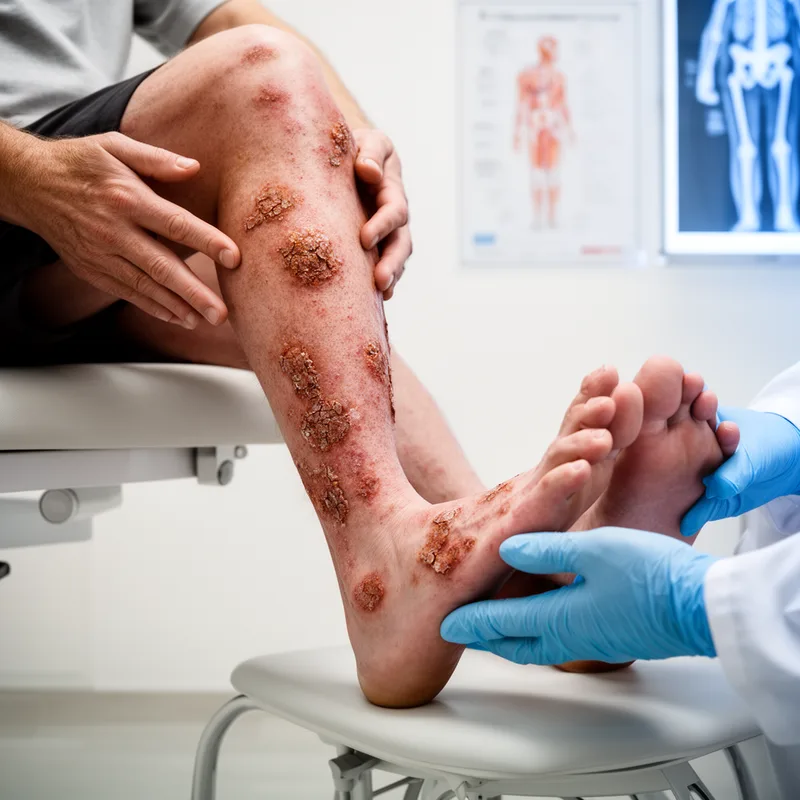
keratoderma blennorrhagica
- noun
- /ˌkɛrəˈtoʊdərmə blɛnəˈrɑːɡɪkə/
- Specialized
- The patient developed keratoderma blennorrhagica on both feet following a recent episode of reactive arthritis.
Examples
-
During the consultation, the doctor explained that keratoderma blennorrhagica could cause painful rashes on the patient's palms and soles.
-
Treatment for keratoderma blennorrhagica often focuses on managing the underlying arthritis.
-
Doctors noted characteristic lesions of keratoderma blennorrhagica during the physical examination.
-
The patient was diagnosed with keratoderma blennorrhagica after showing symptoms.
-
Many dermatologists are familiar with keratoderma blennorrhagica.
-
After the diagnosis of keratoderma blennorrhagica, the patient learned that it often occurs with conditions like reactive arthritis.
-
The dermatologist recommended specific treatments for managing keratoderma blennorrhagica, highlighting its symptoms on the affected areas.
Synonyms
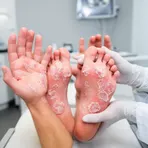
A skin disease that causes scaly rashes on the palms and soles
Surface Forms
Morphology
keratoderma + blennorrhagica
Although 'keratoderma' denotes thickened skin and is somewhat analyzable, 'blennorrhagica' is a specialized, Greek-derived medical element (not found in the supplied dictionary entry) and carries technical clinical implications that a B1 learner would not know. The combined label is a rare, domain-specific medical term whose full meaning (association with reactive arthritis and mucous-related pathology) cannot be derived from the constituents by an average B1 learner.
Etymology
Keratoderma blennorrhagica comes from old Greek roots: kerato + derma meaning 'hard or horn-like skin' and blennorrhagica meaning 'mucus flow'. Doctors used these images because the condition makes the hands and feet thick, scaly and sometimes crusty, so the name helps picture the skin problem.

