
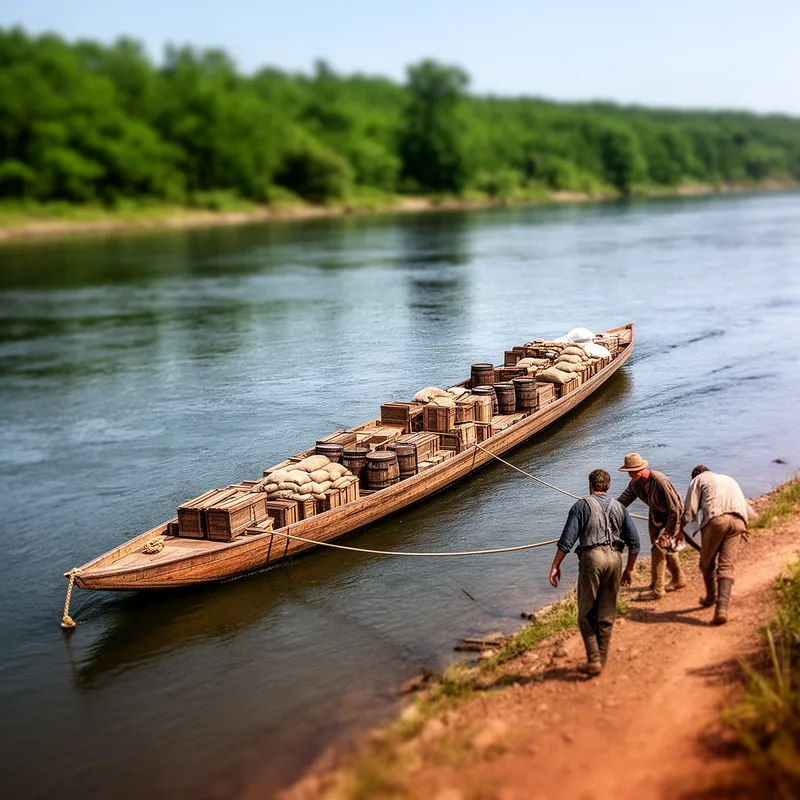
keelboat
 1
9.6
1
9.6

- noun
- /ˈkiːlboʊt/
- Archaic
- Josie Montez started to follow the panicky men, but the keelboat began to break up, the hull cracking in two amidships.
- keelboat and pirogues
- loading the keelboat
- two keelboats
Examples
-
Jocko had decided, for all of them, that it would be better if they did not try to find a keelboat ahead to take them on.
Fiction book (1994) -
With its shallow draft, the keelboat did well on such a river as the Missouri.
Fiction book (1994) -
The unwieldy keelboat, a hundred feet long and twenty feet wide, gained headway mainly through the efforts of the voyageurs.
Fiction book (1994) -
Men were climbing over the broken hulks of the keelboats, salvaging their packs, food, weapons, traps, odds and ends.
Fiction book (1994) -
As the work got harder, the men stopped singing, but Big 'Un kept up a steady chant as he steered the keelboat upriver, guiding the helm with one hand and swatting at mosquitoes with the other.
Fiction book (1994) -
Now, as his sluggish keelboat pulled into the harbor of New Orleans, droves of "fish crows" (ospreys) greeted him grimly, hovering near the docks.
Academic text (1999) -
The shallow waters of the river made it perfect for his keelboat to transport goods efficiently.
-
They rowed the keelboat carefully through the narrow channels of the marsh.
-
After weeks of travel, their keelboat finally reached the trading post along the riverbank.
Synonyms
 57
3.9
57
3.9
A large flat boat that carries heavy goods on rivers or canals
 18
2.5
18
2.5
A boat that travels on a river, often used for tours or fun
 1
8.1
1
8.1
A long boat with a flat bottom and square ends used to carry heavy loads on rivers


 1
3.2
1
3.2
A long narrow boat that carries people or goods on canals
 1
2.9
1
2.9
A boat that carries people or goods along a river

A long, thin boat that travels on canals and carries people or goods

A long, thin boat used on canals to carry goods
How Shallow

Surface Forms
Morphology
Etymology
Keelboat is made from keel + boat, where keel is the bottom part of a ship, like a 'backbone' that keeps it steady. So a keelboat is a boat with that strong bottom for stability, built to carry goods on rivers and move by oars or towing rather than by sails.