
karyokinesis
- noun
- /ˌkɛəriəʊkɪˈniːsɪs/
- Specialized
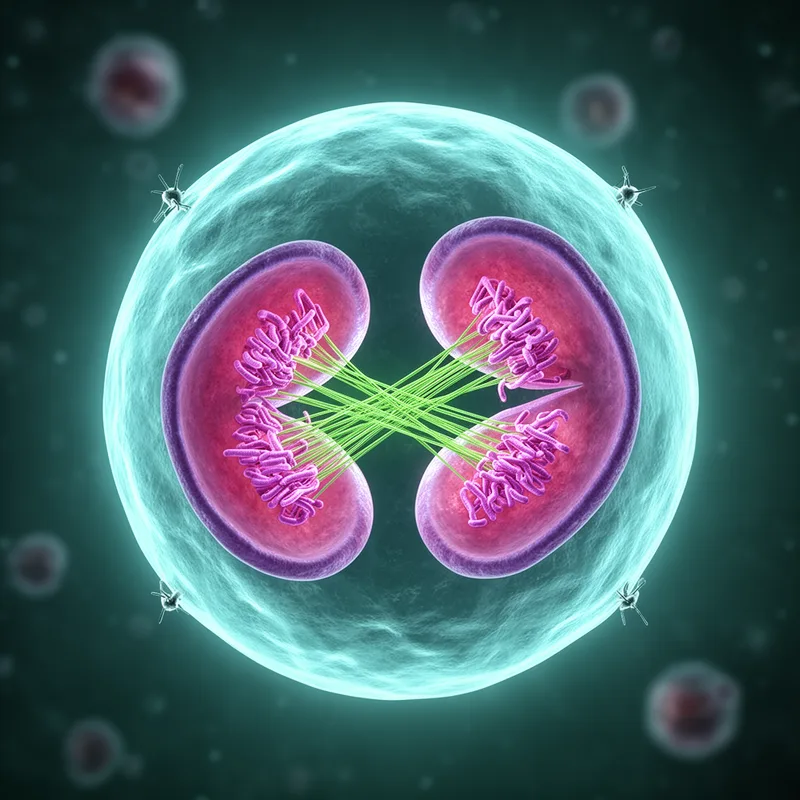
- During karyokinesis, the cell's nucleus divides to ensure each daughter cell receives an identical set of chromosomes.
Examples
-
In this review, we focus on a critical component of karyokinesis, the partitioning of the genome contained in the nucleus.
Academic text (2009) -
This is accomplished by the mitotic spindle, a highly conserved feature of karyokinesis in the cells of multitudes of organisms that have been examined by light or electron microscopy.
Academic text (2009) -
The study of karyokinesis helps scientists understand how cells replicate and maintain genetic material.
-
Errors in karyokinesis can lead to conditions like cancer, as cells may not divide properly.
Surface Forms
Morphology
Etymology
Karyokinesis comes from Greek parts karyo- meaning 'nucleus' and -kinesis meaning 'movement', the same root as kinetic. So karyokinesis literally means the 'movement of the nucleus', which helps you remember it is the step when a cell's nucleus divides during cell division.

