
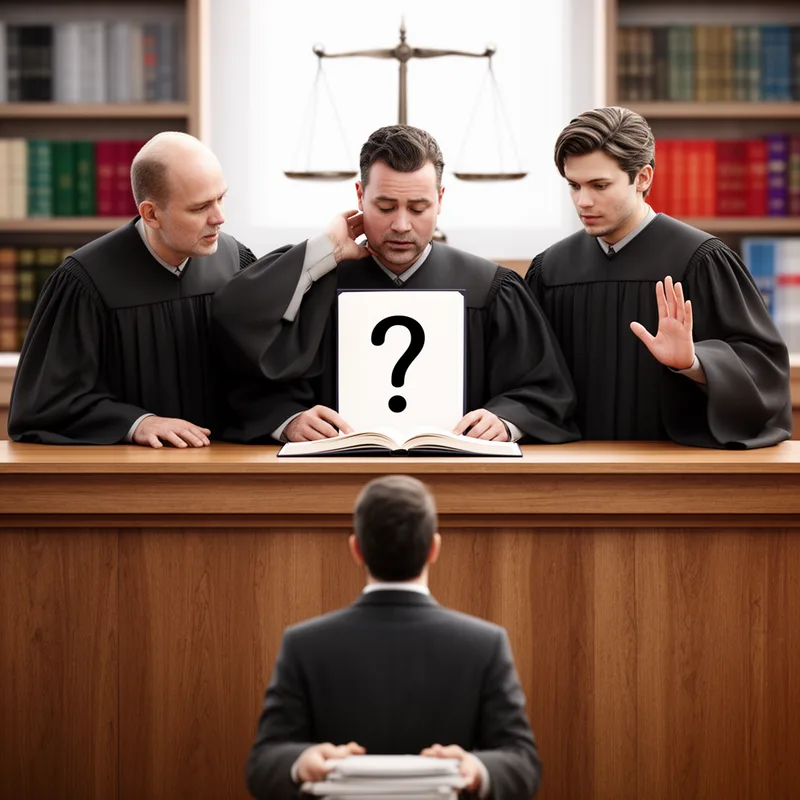
justiciability


 1
9.9
- noun
- /dʒʌsˈtɪʃəˌbɪlɪti/
- Formal
- Judges often assess justiciability before deciding to take on cases that involve complex constitutional issues.
- justiciability in courts
Examples
-
It is indeed only a modest stretch to say that the courts' justiciability doctrines exist precisely to permit courts to avoid deciding such questions.
Academic text (2018) -
In cases that would seek to undermine the ability of the agency to determine rates (what some courts call a typical "justiciability" case), the court is asked to determine a lower rate by assessing how much defendants have inflated the rate through their alleged wrongdoing. Courts refer to the doctrine as the "filed rate" and "filed tariff" doctrine interchangeably.
Academic text (2017) -
As the Supreme Court has often emphasized in the related contexts of standing and justiciability, courts should play a limited role in a democratic society, with more authority properly residing with the more representative branches of government.
Academic text (2017) -
It is important not to overstate the firmness or completeness of this point; the Court is not consistent in applying justiciability doctrines, as many have observed.
Academic text (2018) -
In legal discussions, justiciability refers to whether a matter can be appropriately resolved by the courts.
-
The concept of justiciability determines if courts can hear cases involving certain political questions.
Surface Forms
Morphology
justiciability = justiciable (semi-transparent) = justici + able + ity
The noun is a regular nominalization formed from the adjective 'justiciable' using the productive suffix '-ity'.
Etymology
The word justiciability comes from justice (from Latin justus 'fair') and the endings -able ('able') and -ity ('state'), so it literally means the 'state of being able' to be heard by a court. That's why justiciability describes whether a court can hear and decide a case.