
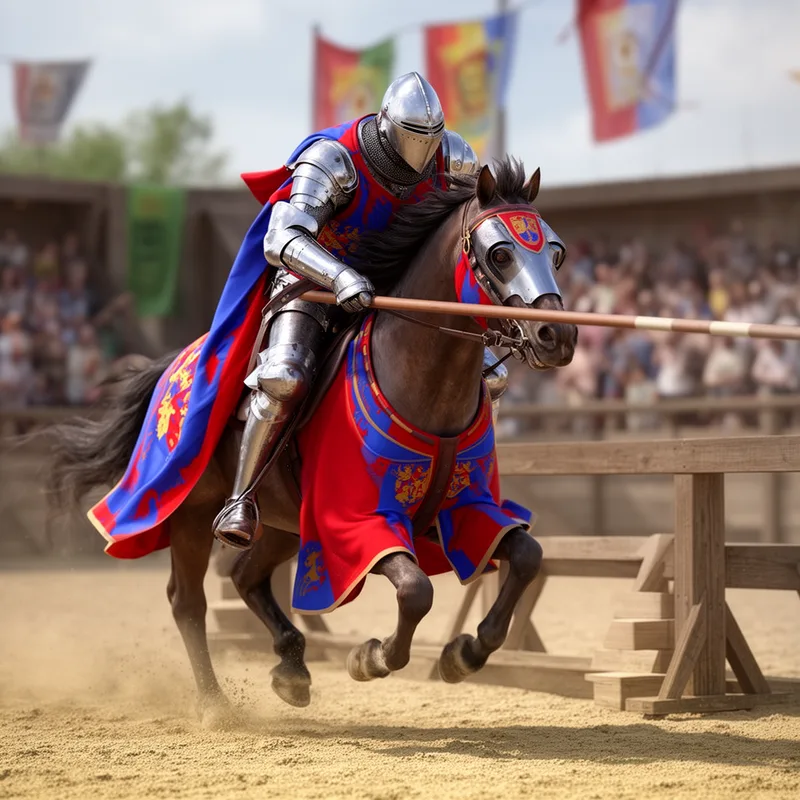
jouster


 1
9.9
1
9.9
- noun
- /ˈdʒaʊstər/
- I'm the champion jouster at the medieval fair.
Examples
-
She always dreamed of becoming a famous jouster and winning the grand championship.
-
There will be fourteen jousters: the Knights of the Blended Rose and the Knights of the Burning Mountain.
Fiction book (1994) -
Some swung broadswords; others, maces or battle-axes; some were jousters riding armored steeds.
Fiction book (1996) -
It was for adulterers that troubadours sang their courtly ballads; it was for the attention of another fellow's wife that the jouster risked the lance.
Fiction book (1990) -
From inside the jouster's tents, the sound of the armorers accomplishing the knights, busy hammers closing rivets up give dreadful note of preparation.
-
During the tournament, the skilled jouster charged at his opponent with a lance.
-
The crowd cheered as each jouster took their place in the arena for the competition.
Synonyms
 1
4.2
1
4.2
A person who takes part in a competition

A person who fights on horseback with a lance in a medieval tournament
How Combative

Surface Forms
Morphology
Etymology
Jouster comes from the old verb joust, which goes back to Latin juxta 'near' and originally meant 'to meet'. A jouster was someone who rode up close to an opponent with a lance in medieval tournaments, so the origin shows why the word names a tournament rider.