
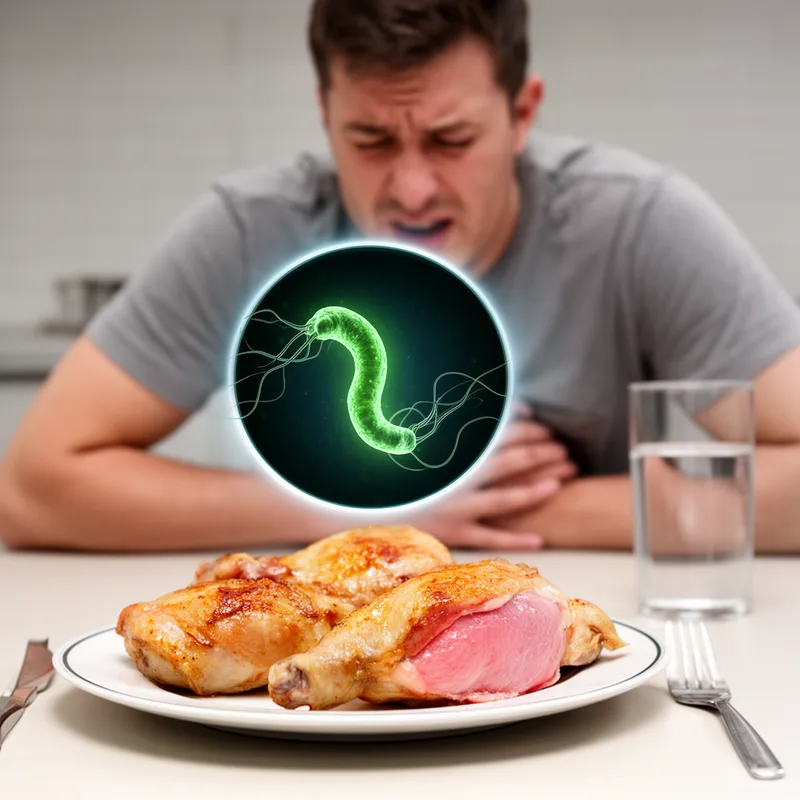
jejuni
- noun
- /ˈdʒɛdʒuˌni/
- Jargon
- The ensuing investigation indicated that the C. jejuni infection was most likely acquired from eating lettuce cross-contaminated with raw chicken.
- Campylobacter jejuni
- C. jejuni
Examples
-
Nasty microbes called Campylobacter jejuni can live in that liquid and on the skin of fresh, uncooked poultry.
Academic text (2004) -
Although it is a pathogen in humans, C. jejuni is a commensal microbe in chickens.
Academic text (2000) -
Campylobacter jejuni. More common in travelers in Asia.
Academic text (2012) -
Though undoubtedly key to C. jejuni's invasions, it is unlikely to act alone.
Academic text (2004) -
Public health officials have traced this path by following the recent increase in fluoroquinolone resistance among Campylobacter jejuni in chickens and people.
Academic text (2000) -
Meats, especially poultry, and raw milk have been sources of Campylobacter jejuni.
Academic text (1996) -
Second on the scientists' hit list of pathogens, Campylobacter jejuni is a major cause of human intestinal inflammation.
Academic text (1996) -
Here's the puzzle: You have two samples of what seem to be the food-poisoning microbe Campylobacter jejuni.
Academic text (2004) -
Infections caused by jejuni often lead to severe stomach cramps and diarrhea.
-
Many cases of food poisoning are linked to jejuni found in undercooked poultry.
Surface Forms
Etymology
Jejuni as a short name for the bacterium comes from the place it was found, the jejunum, the middle part of the small intestine. Because the germ was first linked to that part of the gut, calling it jejuni connects the bug to where it lives in the body.

