
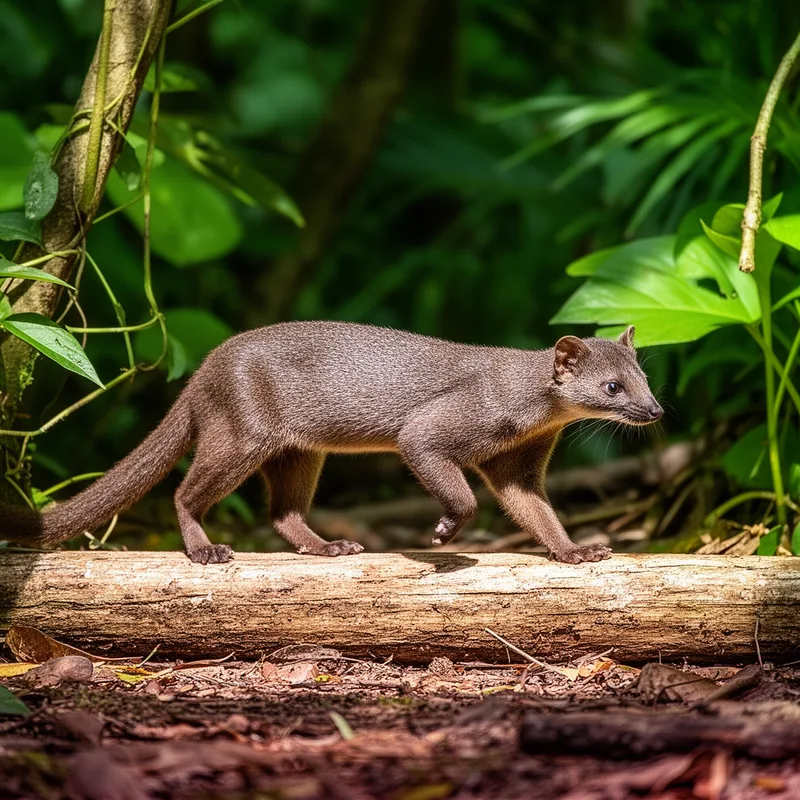
jaguarundi cat
- noun
- /ˌdʒæɡwəˈrʌndi kæt/
- US
- The jaguarundi cat is known for its sleek, weasel-like appearance and secretive behavior.
Examples
-
Unlike most felines, the jaguarundi cat is active during the day and travels widely in search of food.
-
Conservationists are working to protect habitats critical to the survival of the jaguarundi cat in Central America.
-
The jaguarundi cat is known for its slender body.
-
Have you ever seen a jaguarundi cat in the wild?
-
The jaguarundi cat prefers dense vegetation where it can hunt small mammals and birds.
-
In the wild, the jaguarundi cat is often found near water sources, where it hunts for fish and amphibians.
-
Researchers are studying the behavior of the jaguarundi cat to better understand its ecological role in its habitat.
Synonyms

A wild cat from Central and South America with a long body, short legs, and a plain coat

A small wild cat with a long body and tail that lives in Central and South America

A small wild cat with a long body and tail from Central and South America

A small wild cat with a long body and tail that lives in forests of Central and South America
How Big


Surface Forms
Morphology
The phrase is directly compositional: 'jaguarundi' names a particular wildcat and 'cat' denotes a feline, so a learner who knows both constituents will understand this refers to a type of cat. This species-name + noun pattern is cross-linguistically common and therefore fully transparent to B1 learners.
Etymology
Jaguarundi cat may come from a word used by native South American people that meant something like 'little jaguar' or 'dog-like jaguar'. Early Portuguese speakers borrowed that word as jaguarundi, and English later added cat, so the name points to the small, long-bodied wild cat found in the Americas.