
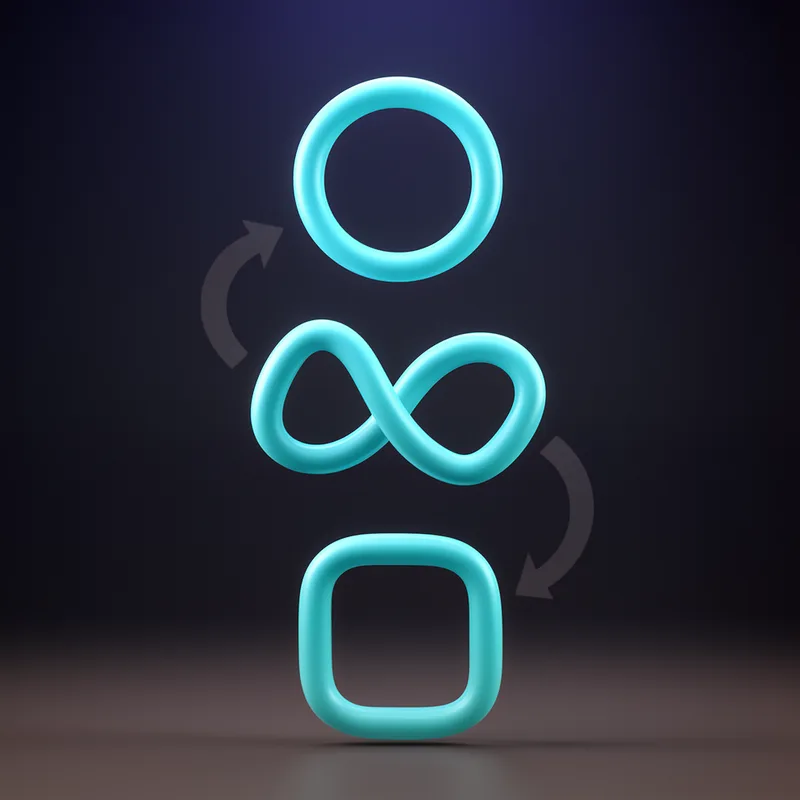
isotopy
- noun
- /ˈaɪsəˌtoʊpi/
- Specialized
- In topology, an isotopy can show that two knots are actually the same up to deformation.
Examples
-
The mathematician explained how an isotopy could transform one curve into another without breaking it.
-
Understanding isotopy is essential for studying the properties of geometric objects in higher dimensions.
-
The concept of isotopy is fundamental in topology.
-
Different isotopies can lead to unique geometric transformations.
-
In topology, an isotopy can show that two knots are actually the same up to deformation.
-
The mathematician explained how an isotopy could transform one curve into another without breaking it.
-
Different isotopies can lead to unique geometric transformations.
Synonyms


 1
9.9
A way to change one shape into another by bending it without cutting or gluing
Surface Forms
Morphology
isotopy = iso + topy
Formed from bound Greek combining elements (iso- + -topy) that are not productive standalone English words, so learners cannot reliably infer the meaning from the parts.
Etymology
Isotopy comes from the Greek parts iso- ('equal') and topos ('place'), so you can picture 'the same place' as a memory hook. In topology, an isotopy is a change that moves a shape into another without cutting or joining it, so the idea of keeping points in the 'same place' during the move explains the name.