
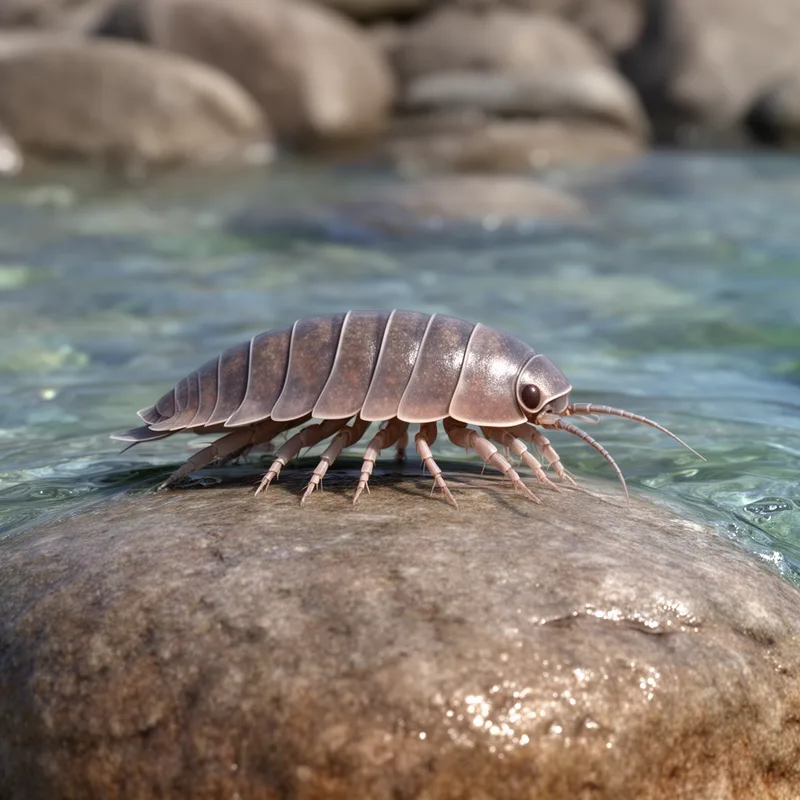
isopod


 1
8.1
1
8.1
- noun
- /ˈaɪsəˌpɒd/
- Specialized
- After consuming most of the tongue of a spotted rose snapper, a parasitic isopod (a tiny relative of crabs and lobsters) hooks onto the floor of the fish's mouth.
- a giant isopod
Examples
-
Both isopods and amphipods are mainly scavengers, which means they eat dead animal and plant material.
Academic text (1993) -
Aquatic isopods resemble roly-polies (pill bugs) somewhat because roly-polies are terrestrial isopods.
Academic text (1993) -
All these isopods are eating this fish alive.
-
North American menhaden, including two hybrids, are hosts for the parasitic isopod.
Academic text (1991) -
You can see in this footage that the oceanographers dove right into a school of fully-grown isopods.
-
Glyptonotus antarcticus, a giant Antarctic isopod four inches long, walked through the rock garden on six pairs of legs.
Academic text (1992) -
At these depths, the ooze was alive with Serolis polita, a flat, thumbnail-sized isopod.
Academic text (1992) -
As we watched, cockroaches, earwigs, isopods, and other small arthropods ran to escape the advancing waves of ants.
Academic text (2003) -
Isopods of this size are most unusual in shallow waters but are abundant in the limiting conditions of the abyssal depths of the world where, as on the Antarctic continental shelf, slow growth to a large size is a common adaptation to the scarcity of nutrients.
Academic text (1992) -
Isopods can be found in various environments, from terrestrial habitats to deep ocean floors.
Surface Forms
Etymology
Isopod comes from the Greek parts iso- 'equal' and -pod 'foot', the same idea you see in tripod, which means 'three feet'. So an isopod is named for having many legs that look much the same, which is why the garden pill bug and many deep-sea animals are called isopods.