

isomer
 1
8.2
1
8.2

- noun
- /ˈaɪsəmər/
- Specialized
- Perhaps the most widely known nuclear isomer is the long-lived hafnium excitation 178m2 Hf.
- isomer decay
- nuclear isomer
- isomer half-life
Examples
-
The widely used isomer decays with a half-life of six hours by emitting a 141-keV photon.
Academic text (2006) -
An isomer is a chemical compound like glucose and fructose, which have the same molecular formula but differ in their atomic arrangement.
-
A special feature of nuclear isomers is that they carry excess energy.
Academic text (2006) -
The six hours are taken almost entirely by the first step in the isomer's descent to the ground state.
Academic text (2006) -
An interesting example of a nuclear isomer is 99m Tc, an excited state of technetium-99.
Academic text (2006) -
Exploiting the practical promise of isomers will require a much-improved understanding of their basic properties.
Academic text (2006) -
So far, the discussion has concentrated on the utility of isomers for illuminating other nuclear phenomena.
Academic text (2006) -
In organic chemistry, cis-trans isomers are classified based on the orientation of functional groups around a double bond.
-
The isomer of butane, isobutane, illustrates how different atom arrangements can produce distinct properties.
Compounds
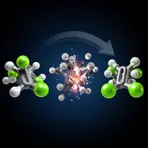
- Specialized
A molecule that can change into another form only if its strong bonds are broken and made again
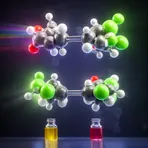
- Specialized
A molecule with the same formula but atoms in a different arrangement giving other properties

- Specialized
One of two chemicals that are mirror images like left and right hands and turn polarized light opposite ways
Surface Forms
Morphology
isomer = iso + mer
Formed from specialized Greek combining forms used in chemistry (iso- + -mer); the compositional logic is clear in a scientific context but not fully transparent to a general B1 learner.
Etymology
The word isomer comes from the Greek parts iso- meaning 'equal' and -mer meaning 'part', and you can see iso- in isotope and -mer in polymer. So an isomer is a molecule that has the same 'parts' or chemical formula as another but has those parts arranged differently, which can give it different properties.