
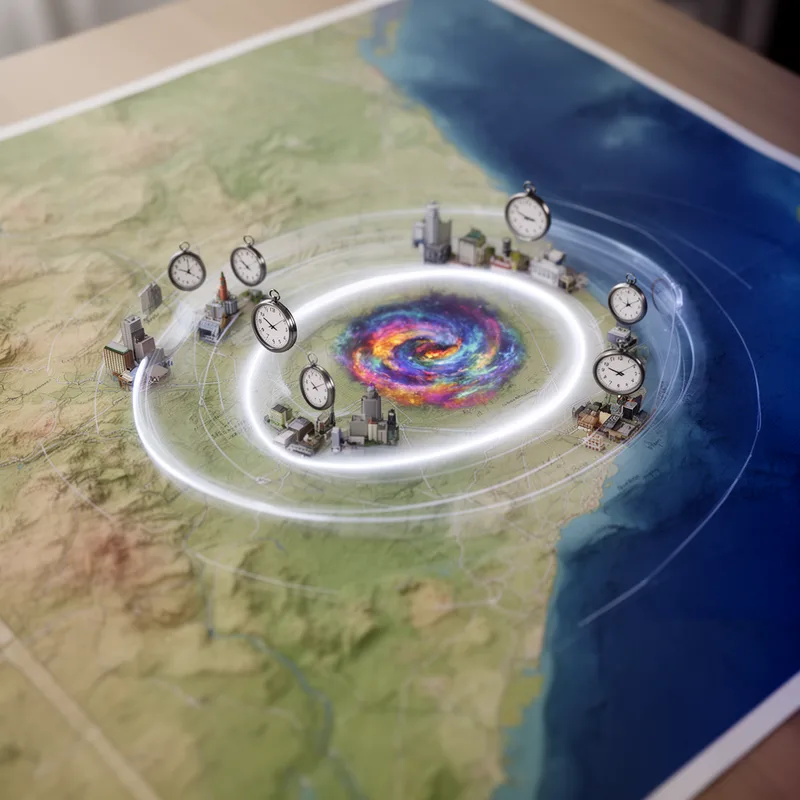
isochrone
- noun
- /ˈaɪsəˌkroʊn/
- Specialized
- An isochrone shows all locations reached by a rescue team within a certain time frame.
Examples
-
An isochrone can help visualize public transport accessibility.
-
The isochrone map showed travel times across the city.
-
Geologists used isochrones to map the simultaneous deposition of volcanic ash across the region.
-
The meteorologists studied the isochrone on the storm track map to determine wind speed progression.
-
An isochrone indicates all areas that can be reached from a central point in the same amount of time.
-
The city planners used an isochrone to assess the accessibility of different neighborhoods to public services.
-
Scientists created an isochrone to illustrate the spread of a pollutant over time in the water supply.
Synonyms
A line on a map that shows places where rocks formed at the same time

A line on a map that joins places with the same height or temperature

A line on a map that connects points with the same value, like temperature

A line on a map that connects places with the same value, like temperature

A line on a map connecting points that have the same value, like temperature or pressure
Surface Forms
Morphology
isochrone = isochron (semi-transparent) = iso + chron
Formed from Greek combining forms iso- (equal) + chron- (time), the literal 'equal-time' meaning is clear in technical contexts but requires knowledge of these combining forms and is not obvious to an average B1 learner.
Etymology
Isochrone comes from the Greek parts iso- meaning 'equal' and chron meaning 'time', the same root you see in chronology. So an isochrone is a line that joins places where something happens at the 'same time', which is why maps use isochrones to show locations reached in the same time.

