
isobar


 1
7.9
1
7.9
- noun
- /ˈaɪsəˌbɑr/
- Specialized
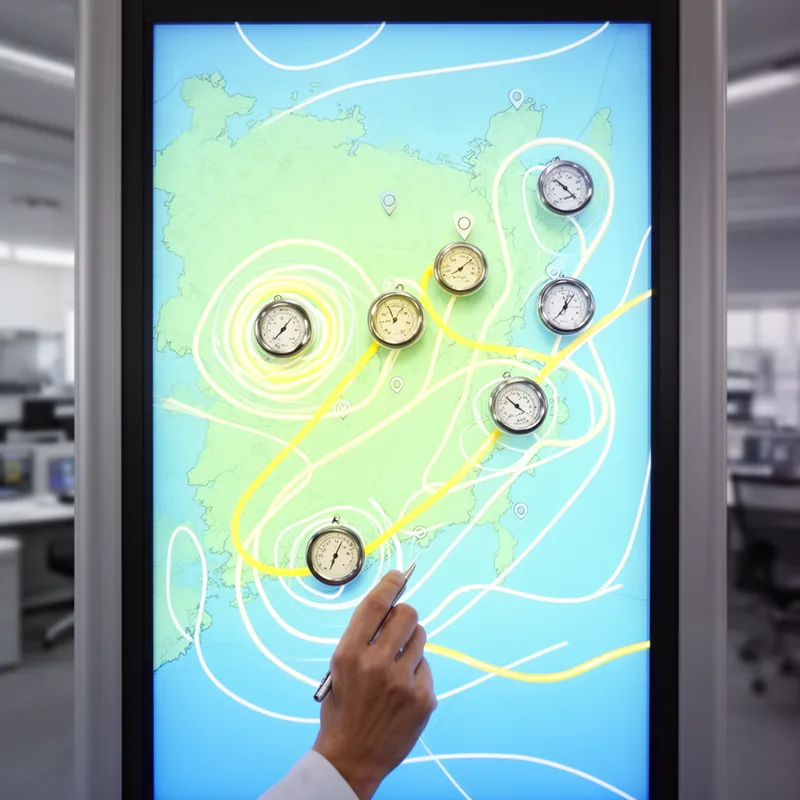
- Meteorologists use isobars to visualize areas of high and low pressure in the atmosphere.
Loading YouTube…
Watch on YouTubeIt flows along the isobars instead of perpendicular across them.
- It flows along the isobars instead of perpendicular across them.
Examples
-
And the closer the isobars are together, the stronger the wind will be.
-
Ice drift is, on average, parallel to the atmospheric-pressure isobars (black lines).
Academic text (2011) -
And on this particular day, the isobars look like this.
-
Instead, it moves along the isobars at right angles to the way pressure wants to push it.
Academic text (1994) -
The air doesn't move directly across the isobars from high to low pressure as you would expect.
Academic text (1994) -
Here are both the height lines and the pressure lines (isobars) on the same chart.
Blog text (14) -
It flows along the isobars instead of perpendicular across them.
-
Conversely, as wind blows out of a high-pressure cell, it also must cross isobars at right angles.
Blog text (18) -
For example, as wind moves toward a low-pressure center, as with a hurricane, its direction is altered so that as wind crosses each isobar surrounding the low, it must cross to the right of a right angle.
Blog text (18) -
On the weather map, the isobars connect locations with equal atmospheric pressure, helping to predict wind patterns.
Synonyms

A line on a map that joins places with the same height or temperature

A line on a map connecting points that have the same value, like temperature or pressure

A line on a map that connects points with the same value, like temperature

A line on a map that connects places with the same value, like temperature
Surface Forms
Morphology
Etymology
The word isobar comes from Greek parts iso- meaning 'equal' and baros meaning 'weight' or 'pressure', the same root as in barometer. So an isobar is a line on a weather map that connects places with the same air pressure.