
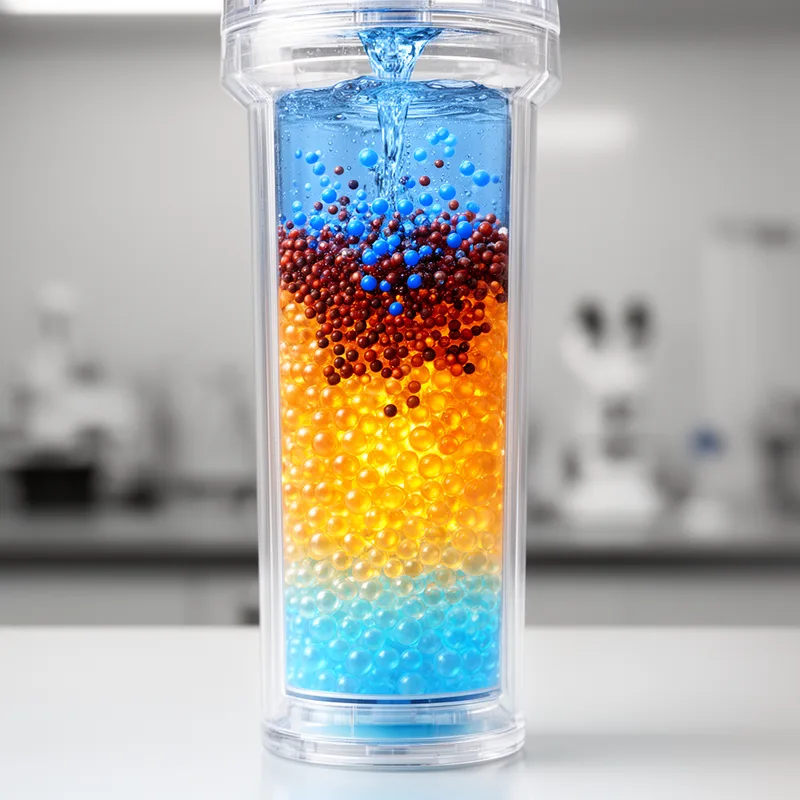
ion-exchange polymer
- noun
- Specialized
- Water treatment systems often use ion-exchange polymers to remove unwanted minerals.
Examples
-
An ion-exchange polymer can remove contaminants from water.
-
Scientists developed a new ion-exchange polymer with improved capacity for heavy metal ions.
-
The effectiveness of the ion-exchange polymer depends on the nature of its functional groups.
-
Many industries rely on ion-exchange polymers for purification.
-
Water treatment plants utilize ion-exchange polymers to effectively eliminate harmful pollutants from drinking water.
-
Researchers are investigating how different ion-exchange polymers can improve the efficiency of chemical separation processes.
-
The new design of the ion-exchange polymer allows for faster ion exchange, enhancing its performance in purification applications.
Synonyms
Tiny hard beads that swap charged particles in water to remove minerals

A man-made material that removes positively charged particles from liquids to purify them
A man-made material that removes negatively charged ions from water
Surface Forms
Morphology
ion-exchange + polymer
The compound is fully compositional: 'ion' (charged particle) + 'exchange' (to swap) describes the action and 'polymer' (a large molecule) denotes the material, so a learner who knows those constituents can infer it is a polymer that swaps or exchanges ions. Although technical, the noun–noun construction follows regular English compounding patterns and is cross-linguistically transparent, making the meaning derivable without prior exposure.
Etymology
Ion-exchange polymer comes from the image of a long plastic chain (polymer) with many small parts that catch and swap charged particles called ions. So, like hands swapping beads, it can 'exchange' ions to remove unwanted ones from water.

