
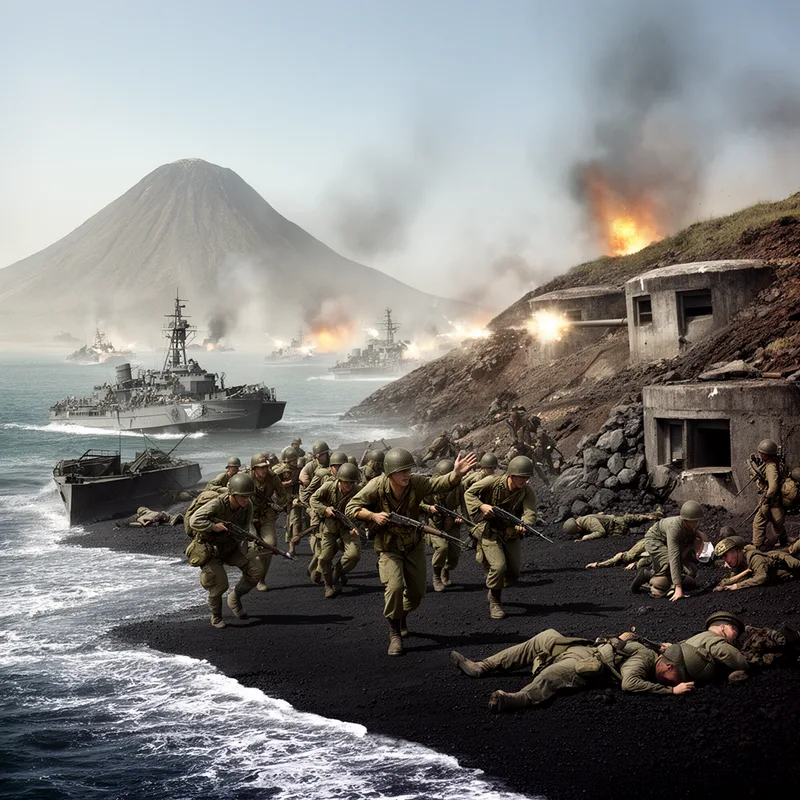
invasion of Iwo
- noun
- /ɪnˈveɪʒən əv ˈiːwoʊ/
- He flew 38 missions, participating in the preliminaries leading up to the invasion of Iwo Jima, and also in the campaigns in Truk and the Bonin Islands.
- the invasion of Iwo Jima
Examples
-
April 1945: White markers designate the final resting place for hundreds of Third and Fourth Marine Division fighters who died during the invasion of Iwo Jima in World War II, in this cemetery located near the beach where the U.S. Marines first established a beachhead.
Blog text (11) -
The American forces launched the invasion of Iwo in February 1945, resulting in fierce fighting with Japanese troops.
-
This was prior to the invasion of Iwo Jima, so the anti-aircraft and fighter plane response was extremely severe.
Blog text (11) -
He was a sailor aboard ARL 15 and drove LCIs to and from the beach during the invasion of Iwo Jima.
Blog text (11) -
During the invasion of Iwo, U.S. Marines faced intense resistance but ultimately secured control of the island.
-
The invasion of Iwo was a critical operation in the Pacific Theater, marking a turning point in World War II.
Synonyms


 1
6.5
1
6.5
A 1945 World War II battle where American forces took Iwo Jima from Japanese soldiers after heavy fighting
Surface Forms
Morphology
invasion + of + Iwo
The phrase is compositionally built from 'invasion' (military seizure) + 'of' (preposition indicating target) + the place name 'Iwo', so a learner who knows these words can infer it means a military attack on Iwo. The structure 'invasion of [place]' is a straightforward, cross-linguistic noun phrase describing an attack on a location, so the meaning is directly derivable from the constituents.
Etymology
Invasion of Iwo comes from a dramatic 1945 attack when U.S. soldiers landed on the small, rocky island Iwo and fought to take it, a moment made famous by a photo of troops raising a flag on Mount Suribachi. So, the phrase refers to that specific 'military operation' when American forces landed on and captured the island.