
intinction


 1
9.9
- noun
- /ɪnˈtɪŋkʃən/
- Jargon
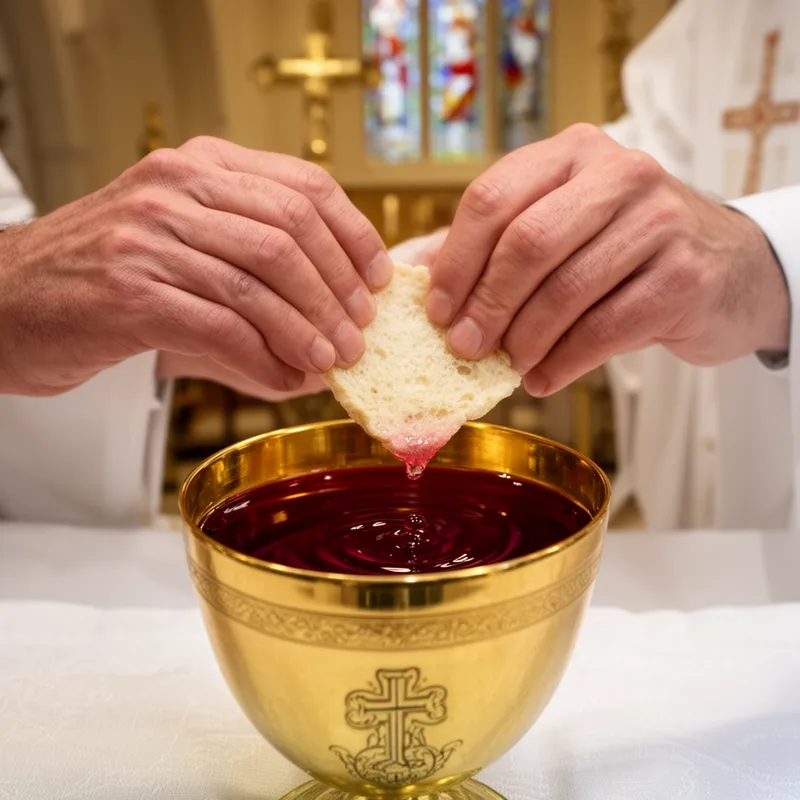
- During the Christian service, the priest demonstrated intinction by dipping the bread into the wine before giving it to the congregation.
Examples
-
If it is unhygienic to receive on the tongue, then it is unhygienic to drink directly from the chalice, except by intinction, which is not really feasible for Communion in the hand.
Blog text (6) -
This leads to the prejudice so many progressive liturgists have toward intinction for Holy Communion and for kneeling to receive.
Blog text (27) -
Since no differences in health were reported among these groups, it was not necessary to determine which method individuals had used to receive the wine (sipping from a common cup, separate cups, intinction, etc.).
Academic text (1997) -
Participants were not asked to indicate how the wine was taken (by sipping, individual cup, intinction, etc.) as this would have added complexity to the survey, perhaps unnecessarily.
Academic text (1997) -
For the Holy Communion, many churches practice intinction to ensure that the participants receive both bread and wine together.
-
The act of intinction allows worshippers to receive the body and blood of Christ in a single gesture during the communion ritual.
Surface Forms
Morphology
intinction = intinct (semi-transparent) = in + tinct + ion
Derived from 'intinct' + '-ion'; the ritual sense is a specific instantiation of 'dipping into', but the specialized religious meaning is not predictable from components alone for general learners.
Etymology
Intinction comes from the Latin parts in- 'into' and tingere 'to dip'. A helpful image is dipping a piece of bread 'into' wine during a service. So in church intinction means the act of dipping the bread into the wine as part of communion.