
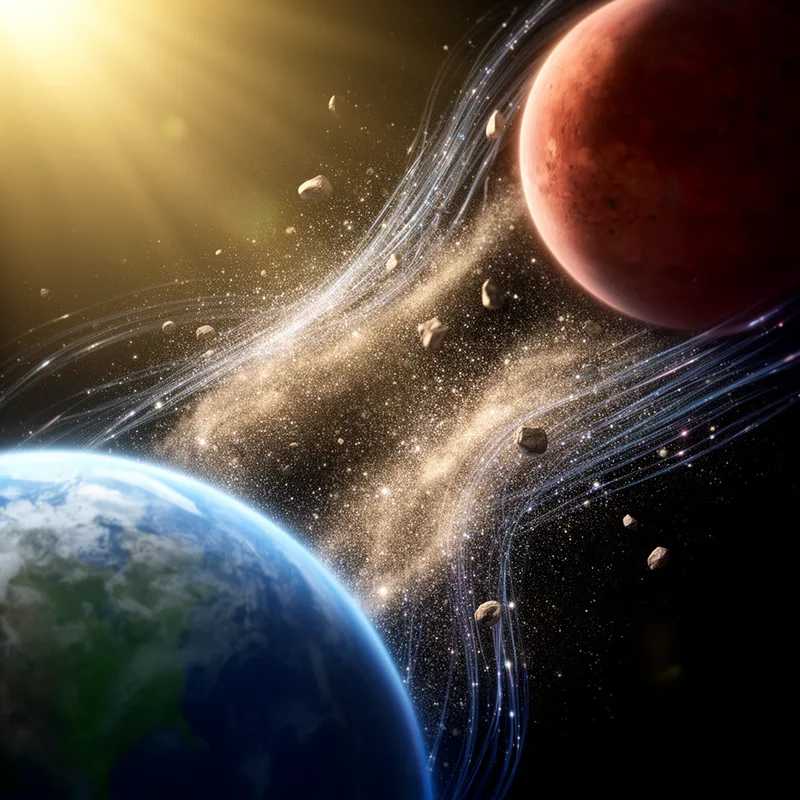
interplanetary medium
- noun
- /ˌɪntərˈplænɪˌtɛri ˈmiːdiəm/
- Specialized
- Early in 2006, Stardust will return to Earth with samples of the interplanetary medium.
Loading YouTube…
Watch on YouTubeOK, so there is no demarcation line, it fades until it blends with the with the interplanetary medium.
- OK, so there is no demarcation line, it fades until it blends with the with the interplanetary medium.
Examples
-
NASA's research focuses on the properties of the interplanetary medium to better understand cosmic phenomena.
-
The amount of dust in the interplanetary medium can affect spacecraft navigation and communication.
-
Friction with the thick interplanetary medium had almost circularized its path and worked together with resonances to make this ever shorter.
Fiction book (2001) -
Cosmic rays, part of the interplanetary medium, can pose risks to astronauts during long space missions.
Surface Forms
Morphology
The meaning 'the matter and energy in the space between planets' is directly derivable from 'interplanetary' (between planets) combined with 'medium' (a material or environment through which something exists). This adjective+noun composition follows normal compositional semantics and is cross-linguistically transparent, so a B1 learner who knows both constituents would readily infer the MWE meaning.
Etymology
The noun interplanetary medium breaks into interplanetary, meaning 'between planets', and medium, meaning 'a space that contains something'. It gives a clear image: the thin 'stuff' of gases, dust and a stream of particles from the Sun that fills the space between planets, so the phrase means the matter and energy found in that space.

