

interplanetary gas
- noun
- Specialized
- The spacecraft detected changes in the interplanetary gas as it traveled beyond Earth's orbit.
Examples
-
Scientists study interplanetary gas to better understand the dynamics of the solar system.
-
Interplanetary gas is primarily composed of hydrogen and helium that flows between the planets.
-
Interplanetary gas plays a key role in shaping the behavior of the solar wind.
-
The interplanetary gas is essential for understanding solar wind.
-
Scientists study interplanetary gases to learn about space weather.
-
The probe measured fluctuations in the interplanetary gas while passing through the asteroid belt.
-
Research on interplanetary gas helps scientists predict solar storms that can affect Earth's atmosphere.
Synonyms
 14
5.4
14
5.4

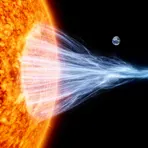
A stream of tiny charged particles that flow from the Sun into space
Surface Forms
Morphology
The meaning 'gas between planets' is directly and transparently derived from combining 'interplanetary' (between planets) with 'gas' (a gaseous substance). The phrase is compositional and follows a standard modifier+noun pattern, so even if the scientific nuance (charged particles/solar wind) is unfamiliar, a B1 learner who knows both constituents can infer the basic meaning.
Etymology
Interplanetary gas is a literal name: inter means 'between', planetary means 'about planets', and gas means a very thin material. Imagine a very thin, invisible wind blowing through space from the Sun and moving 'between' the planets. That's why the phrase means the thin stream of gas and particles that flows through space.