
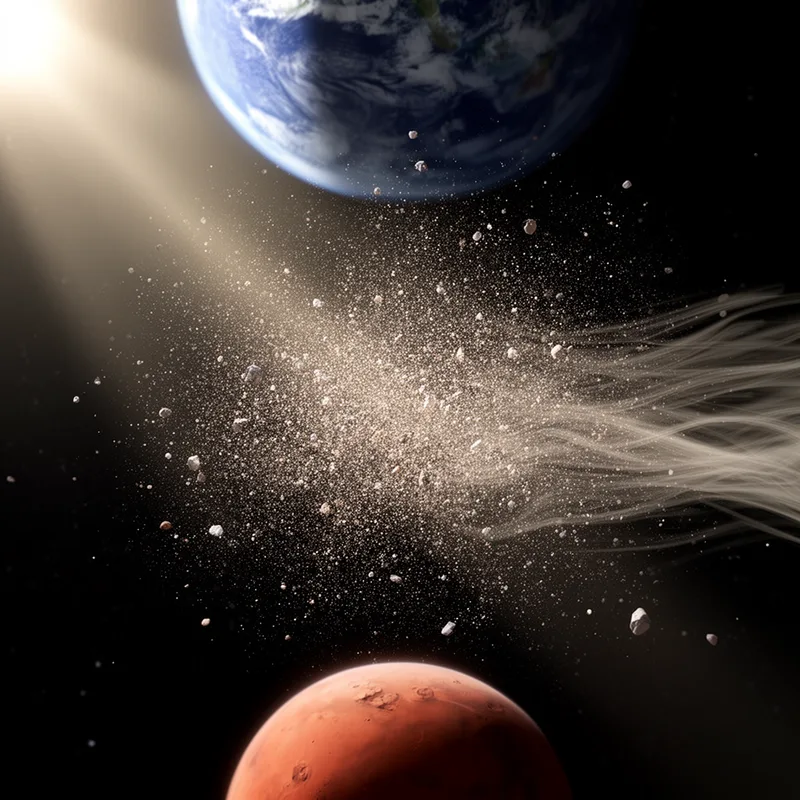
interplanetary dust
- noun
- Specialized
- This scanning electron microscope image shows an interplanetary dust particle known as a 'cosmic sphere.'
- interplanetary dust particles
Examples
-
Most meteors are grains of interplanetary dust that glow from friction with the Earth's atmosphere and are completely vaporized in a few seconds.
Academic text (1992) -
This scanning electron microscope image shows an interplanetary dust particle known as a "cosmic sphere."
Academic text (2001) -
This conclusion has been supported by analysis of carbonaceous meteorites and interplanetary dust particles, whose composition is nearly identical to that of comets.
Academic text (1996) -
Sometimes it involves scientists like author Monika Kress examining tiny interplanetary dust particles with a scanning electron microscope.
Academic text (2001) -
Because of the low speeds of the asteroidal particles, it is likely that almost all of the unmelted interplanetary dust particles collected in the stratosphere by research aircraft are asteroidal particles delivered to us from the dust ring.
Academic text (1994) -
These micrometeorites, also known as "interplanetary dust particles," are shed by asteroids banging into one another and by comets evaporating as they wander too close to the Sun.
Academic text (2001) -
Most meteors are grains of interplanetary dust that glow from friction with the Earth's atmosphere and are completely vaporized in a few seconds.
-
Sunlight reflected from interplanetary dust farther out provides the faint, hazy zodiacal light seen under dark, rural skies after dusk and before dawn.
Surface Forms
Morphology
The meaning is directly derivable from 'interplanetary' (between planets) + 'dust' (tiny particles): it straightforwardly refers to tiny particles located in space between planets. This adjective+noun composition follows regular English compounding patterns and is cross-linguistically transparent, so a B1 learner who knows the constituents will understand it.
Etymology
Interplanetary dust names tiny bits of dust that float 'between' the 'planets'. People noticed a faint glow or cloud made by these bits in the sky, so the name shows they are very small particles traveling among the planets.

