
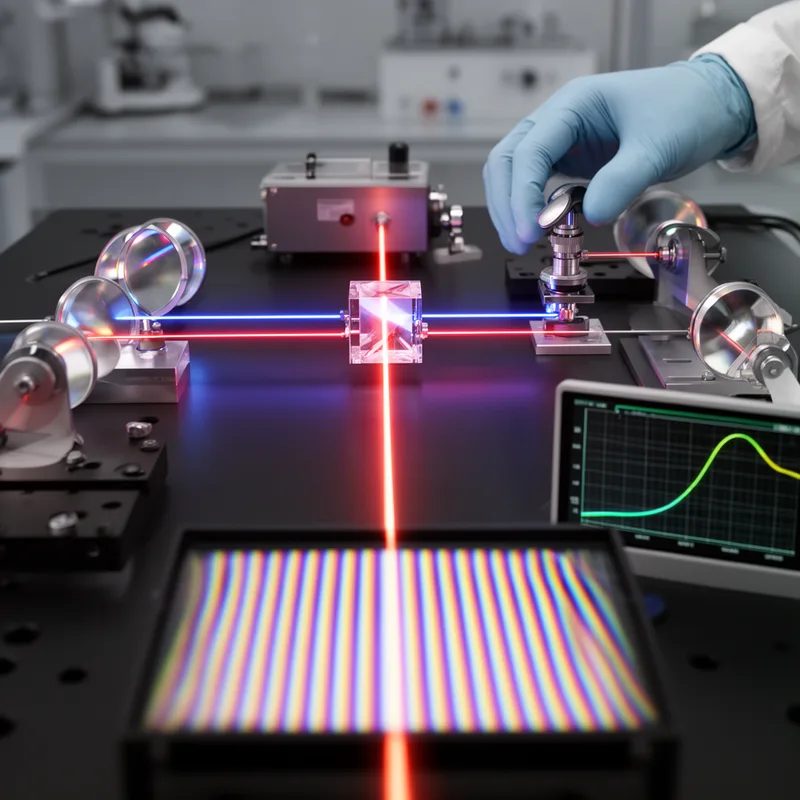
interferometric
 1
9.9

- adjective
- /ˌɪntərfɪəˈrɑːmɛtrɪk/
- Specialized
- Optical astronomers are making rapid strides in introducing interferometric techniques to the near-infrared and optical.
- interferometric technique
- interferometric measurement
Examples
-
By using interferometric methods, scientists can achieve highly precise measurements in their experiments.
-
The interferometric measurement beautifully demonstrates the modulation of the instantaneous frequency.
Academic text (1994) -
A standard reference for all who want to analyze radio interferometric data.
Academic text (1996) -
Instead, one has to resort to interferometric techniques.
Academic text (2005) -
There are also other alternatives to interferometric phase determination.
Academic text (2001) -
Whereas interferometric phase determination requires coherent sources, quantitative propagation-based phase measurement can be made with only partially coherent sources.
Academic text (2001) -
One can determine the source's size by an ingenious interferometric technique developed in the 1950s by Robert Hanbury-Brown and Richard Twiss (HBT) to measure stellar diameters.
Academic text (2003) -
The researchers employed interferometric techniques to analyze the data from their optical experiments.
-
The new satellite is equipped with interferometric technology to monitor the Earth's surface changes.
Surface Forms
Morphology
interferometric = interferometry (semi-transparent) = interfere + metry + ic
The adjective is a straightforward derivation from the noun 'interferometry' with the suffix '-ic' meaning 'relating to'.
Etymology
Interferometric comes from interference, what waves do when they meet and make a pattern, and from metric, meaning 'measuring', as in meter. So interferometric describes using wave interference to make very accurate measurements.