
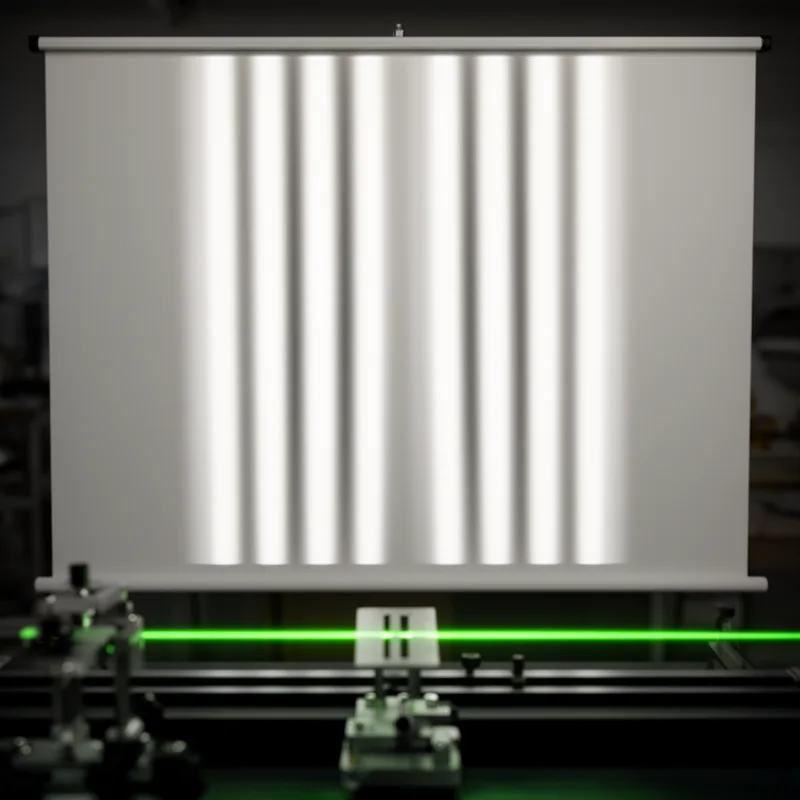
interference fringe
- noun
- /ˌɪntərˈfɪrəns frɪndʒ/
- Specialized
 :
banda de interferencia
:
banda de interferencia
- In the first step, condensates 1 and 2 (or 2 and 3) produce interference fringes (periodic variations in the density of the condensate).
Examples
-
Searching for this speculative primordial background at high frequencies, where stochastic noise is tolerable, can be accomplished by using interferometers that greatly reduce the phase noise of the interference fringes at the cost of reduced bandwidth.
Academic text (1999) -
For example, we measure the optical phase to determine the motion of an interference fringe at radio frequency rather than near DC.
Academic text (1999) -
The key to interferometry is to overlay one coherent wave with another and use the resulting interference fringes to deduce the relative phases of the two waves.
Academic text (2001) -
This time difference is manifested in the interference pattern when the two laser beams recombine on the way to the photocetector, which can measure phase shifts to a few ten-billionths of an interference fringe.
Academic text (1999) -
When two light waves overlap, they create an alternating pattern of light and dark bands known as an interference fringe.
-
The scientist observed the interference fringes through the microscope as they demonstrated the properties of light diffraction.
-
In experiments, researchers often analyze the spacing between interference fringes to understand wave characteristics.
Synonyms
 1
9.1
1
9.1

A light or dark band seen when light waves meet and make a pattern
Surface Forms
Morphology
interference + fringe
The phrase is directly compositional: 'interference' denotes the wave process and 'fringe' denotes a band, so together they mean a band produced by interference/diffraction of waves. This follows a regular noun–noun modification pattern (cause + result) and is cross-linguistically transparent, so a B1 learner who knows both constituent meanings should be able to infer the MWE.
Etymology
Interference fringe comes from a simple picture: imagine two waves of light meeting and making bright and dark stripes where they add together or cancel each other. So interference shows the waves affecting each other and fringe means a 'band', which is why it means 'one of the bands of light or dark'.