

intercision
- noun
- /ˌɪntərˈsɪʒən/
- Specialized
- During the procedure, an intercision was necessary to separate the two organs.
Examples
-
Careful intercision can help prevent damage to surrounding structures in complex surgeries.
-
An intercision was made.
-
The intercision allowed the surgeon to access the deeper layers of tissue safely.
-
The intercision was necessary!
-
The surgeon performed an intercision to remove the damaged tissue from the patient's leg.
-
During the procedure, the intercision was carefully made to ensure no surrounding nerves were impacted.
-
The intercision of the plant stem allowed for successful grafting of a new species.
Synonyms

 337
1.0
337
1.0

A wound where the skin is opened by something sharp
 87
5.3
87
5.3
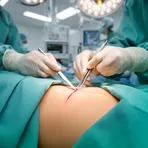
A cut a doctor makes in the body during an operation
 70
2.7
70
2.7
Making an opening or removing part from something with a sharp tool
 2
8.3
2
8.3
A cut across something, for example a nerve or plant stem
 2
1.9
2
1.9
Cutting food into thin pieces for eating or cooking
 2
5.8
2
5.8
Cutting something so it becomes separate
 1
3.8
1
3.8
A cut a surgeon makes in the body during an operation


 1
9.8
1
9.8
The cutting or splitting of something into parts

An act of cutting something off, naturally or by surgery
Antonyms


How Deep

Surface Forms
Morphology
intercision = intercise (semi-transparent) = inter + cise + ion
The word is formed by a verb 'intercise' + '-ion', meaning 'the act of cutting between'; however, the stem 'cise' is not a common standalone word, so the composition is not fully transparent to learners.
Etymology
Intercision comes from the Latin parts inter- 'between' and -cision 'to cut', the same root as incision. So, in medicine an intercision is an intentional 'cutting between' parts to separate them.