
interaural
- adjective
- /ˌɪntəˈɔrəl/
- Specialized
 :
interaural
:
interaural
- The interaural latency difference (ILD) of wave V was also described by Selters and Brackmann in 1977.
- interaural level differences
- interaural latency
- interaural level
Examples
-
The binaural system rapidly loses sensitivity to any ITD at all as the frequency of the wave increases from 1000 to 1500 Hz—exactly the range in which the interaural phase difference becomes ambiguous.
Academic text (1999) -
In 1948, Lloyd Jeffress proposed that the auditory system processes interaural time differences by using a network of neural delay lines terminating in e-e neurons.
Academic text (1999) -
This information is included in this paper to remind physicians that large interaural latency differences are encountered normally with this technique.
Academic text (1995) -
Interaural level differences, calculated for a source in the azimuthal plane defined by the two ears and the nose.
Academic text (1999) -
Figure 1 shows the mean interaural latency differences at each stimulus frequency for the intensity levels evaluated.
Academic text (1995) -
Some of the most obvious advantages include the reduction of ambient noise during testing (49, 50) and the significant increase in interaural attenuation (51, 52).
Academic text (2001) -
Figure 1 also demonstrates that, given identical intensity levels, interaural latency differences also increase with decreasing frequency for specific tone pips of 500, 1,000, 2,000, and 3,000 Hz.
Academic text (1995) -
The operations of interaural level and time difference cues and of spectral cues have normally been tested with headphones or by sound localization experiments in anechoic rooms, where all the sounds travel in a straight path from the source to the listener.
Academic text (1999) -
The experiment measured the interaural time difference to understand how humans perceive sound direction.
-
Researchers found that the interaural level difference plays a crucial role in localizing high-frequency sounds.
Synonyms

 1
7.4
1
7.4

Using both ears to hear sound, often with headphones

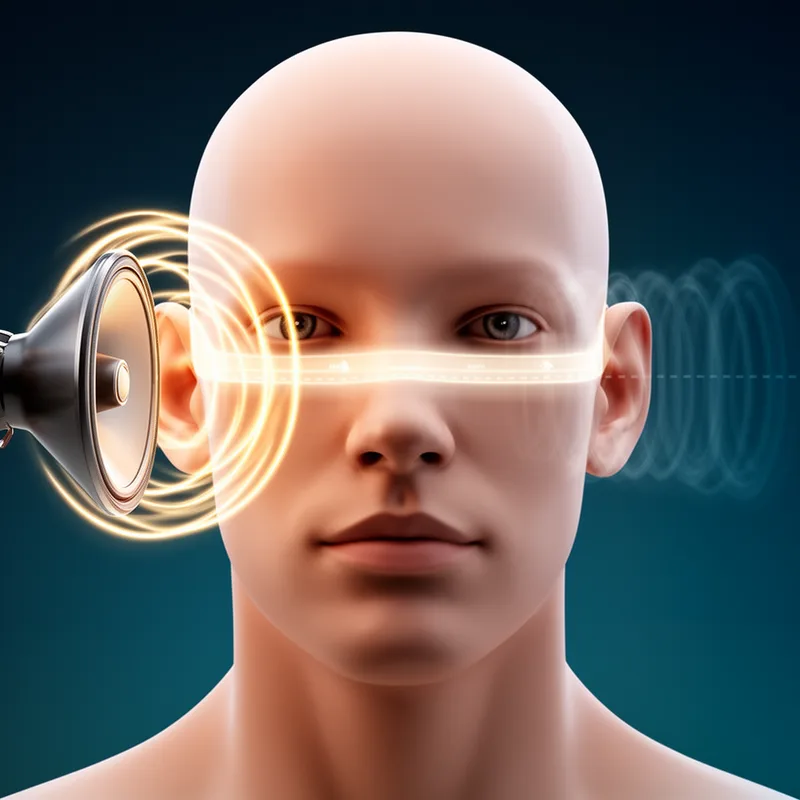
Relating to both ears, especially the distance between them

Hearing with both ears to judge where sounds come from
Surface Forms
Morphology
interaural = aural (semi-transparent) = inter + aur + al
The word is formed regularly by adding inter- to aural, so the immediate structural relation is clear.
Etymology
Interaural comes from the parts inter- 'between' and aural 'relating to the ear'. So interaural literally means 'between the ears', which is why we use it for differences in sound that help us know where a sound comes from.