

innominate
- noun
- /ɪˈnoʊməˌneɪt/
- Specialized
- Each innominate consists of ilium, ischium, and pubis and bears an acetabulum for the femur, as it does in land mammals.
Examples
-
The sacrum and left and right innominates form a strong and rigid bony girdle that anchors the hind limbs and supports much of the body in locomotion.
Academic text (2001) -
The femur (Fem.) is substantial in size, and there is a strong, weight-bearing joint between the sacrum and innominate (Inn.).
Academic text (2001) -
In modern whales, in contrast, the sacrum cannot be recognized, as there are no fused vertebrae and no vertebra has a joint for the innominate.
Academic text (2001) -
The innominates are not connected to the vertebral column, but these whales retain femurs that are longer than in modern cetaceans.
Academic text (2001) -
The sacrum comprises four fused vertebrae, and these articulate with the innominate bones (Figure 11).
Academic text (2001) -
In fact, the innominate in modern cetaceans is a tiny bar of bone lacking an acetabulum and distinct ischium, pubis, and ilium.
Academic text (2001) -
The sacrum is a series of vertebrae (five in humans) that are fused to each other and connect to the innominates at the first (most anterior) of these vertebrae.
Academic text (2001) -
The innominate bone plays a crucial role in the structure of the pelvis, allowing for movement and support during walking.
-
At birth, the innominate is made up of three separate bones, which eventually fuse into a single bone known as the hip bone.
-
Surgeons often examine the innominate to assess pelvic stability and to plan hip replacement surgeries.
Synonyms

 2
3.8
2
3.8

A large bone at the side of the body that makes the top of the hips
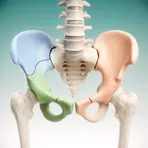
A large hip bone on one side of the pelvis that has three parts
Compounds

- Specialized

 1
7.9
1
7.9
One of two large chest veins that carry blood from the head and arm to the heart

- Specialized
Large blood vessel from the heart that supplies the right side of the head, neck, and arm
How Technical

Surface Forms
Morphology
Etymology
Innominate comes from Latin parts in- 'not' and nominare 'to name', so it means 'not named'. In anatomy, the noun innominate was used for the large hip bone when it did not have a special name.