

ingrained in
 15
5.5
15
5.5

- idiom
- /ɪnˈɡreɪnd ɪn/
- Many attitudes towards gender roles are ingrained in society from a young age.
- deeply ingrained in
- ingrained in our culture
- firmly ingrained in
Loading YouTube…
Watch on YouTubeI feel like it's so deeply ingrained in my idea of who I am.
- I feel like it's so deeply ingrained in my idea of who I am.
- So I think that's very much ingrained in the culture.
- Is there changing one's mind on this or is this so ingrained in us that it just is?
- And that mission statement, so to speak, really is ingrained in us for those four years.
- But I think it was really ingrained in me at a young age.
- And the cherry on top as to why perfectionism has been so ingrained in my head is my job.
- And so maybe empathy is as deeply ingrained in our evolutionary history as self-interest is.
- But that process is now ingrained in our scientists, which is like delightful for me to see.
- But I think it was just ingrained in me, like with how I carried myself.
- But but that's something that's sort of been ingrained in people here in the United States for a very long time.
- Yeah, sort of loosening your grip on the the ideology that had been so heavily ingrained in your life.
Examples
-
Eventually, the new value system becomes ingrained in their minds.
Academic text (1999) -
I feel like it's so deeply ingrained in my idea of who I am.
-
So it's worth kind of having it ingrained in your mind.
-
It's just, after you give birth, it becomes ingrained in you.
-
Good education, good training, and lifelong training are ingrained in their culture.
Academic text (1996) -
So I think that's very much ingrained in the culture.
-
The tradition of woodworking is deeply ingrained in their culture and local folklore.
Academic text (2008) -
Rationality is ingrained in the Swedish mentality, and the practical solution is always highly valued.
Academic text (2006) -
And so maybe empathy is as deeply ingrained in our evolutionary history as self-interest is.
-
The belief that hard work leads to success is deeply ingrained in our culture.
Synonyms
 144
5.1
144
5.1
A natural part of something that is always there
 24
4.7
24
4.7
A feeling or belief that people cannot easily change
 11
6.9
11
6.9
Deeply fixed in a person or group and hard to change
 8
4.8
8
4.8
A feeling, belief or tradition that is very strong and hard to change
 6
6.4
6
6.4
Firmly fixed in a person, especially a habit or belief, so it is hard to change
 6
6.7
6
6.7
Strongly fixed and hard to change, often about beliefs or habits
 3
3.7
3
3.7
Firmly connected to a particular place, idea, or feeling
 1
8.8
1
8.8
A quality someone has from birth that is hard to change

Deeply fixed ideas or feelings that are hard to change

Firmly fixed in a person's mind or character

Held firmly inside something or made a normal part of a group
Antonyms

How Deep

Surface Forms
Morphology
The adjective 'ingrained' already encodes the meaning 'firmly established/difficult to change', and the preposition 'in' merely indicates the location or domain (e.g. 'in her personality'), so the combined meaning is directly compositional. This locative composition is cross-linguistically common and should be immediately understandable to a B1 learner who knows both constituent words.
Etymology
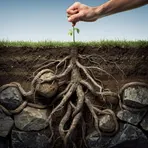
The phrase ingrained in comes from the picture of colour sinking deep into the grain of cloth so it could not be washed out. So when a habit or idea is ingrained in someone, it is 'hard to change' and stays with them.