
industrial arts


 1
3.7
1
3.7
- noun
- /ɪnˈdʌstriəl ɑrts/
- US
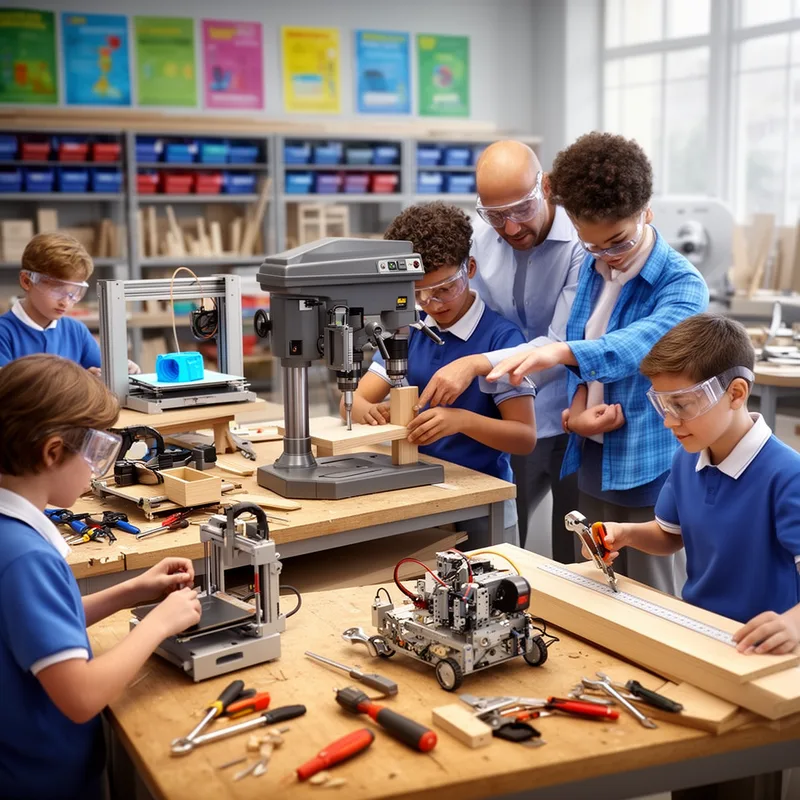
- Students in the high school learned about woodworking and metalworking in their industrial arts classes.
- industrial arts technology
- industrial arts programs
- industrial arts teacher
Examples
-
In the 1980s, focus shifted away from transforming industrial arts to the development of a new curriculum for a new subject: "technology education."
Academic text (2011) -
Our history as manual arts and industrial arts instructors has served us well, yet it is just that: history.
Academic text (2007) -
The first mission was to take the current middle school learning experiences from industrial arts to technology education.
Academic text (2010) -
The shift from the "industrial arts" to "technology education" did not achieve success overnight.
Academic text (2011) -
Both authors identified issues critical to industrial arts and technology education, respectively.
Academic text (2011) -
Thus, industrial arts morphed into industrial technology and then into technology education.
Academic text (2009) -
Vincent made the decision to become a technology educator while studying industrial arts in high school.
Academic text (2009) -
Students can make their own flutes using tools in your school's industrial arts classrooms.
Academic text (2006) -
We shared common core values about the potential of industrial arts in the context of education for all, as advocated by the profession's leaders.
Academic text (2013) -
How shall industrial arts relate to a fresh new definition of vocational education in Virginia's public schools?
Academic text (2013)
Antonyms

 25
3.7
25
3.7
College or university studies that teach broad knowledge and thinking skills across subjects like literature and history
How Practical
4
3.2
 4
3.5
4
3.5
- US
1
3.7
27
1.0
∞
1.0
Surface Forms
Morphology
The meaning is directly derivable from the constituents: 'industrial' (relating to industry or manufacturing) + 'arts' (school subjects or practical skills), so a learner who knows both words can infer this refers to a school subject about industrial/practical skills and machinery. Although 'arts' can sometimes evoke fine arts, in educational contexts it commonly means subject area, making the compound readily understandable to B1 learners.
Etymology
Industrial arts comes from two simple ideas: industrial, meaning work with machines and factory tools, and arts, meaning skilled hand work or craft. In early trade and technical schools, students learned to use tools and build real things with their hands, so the name came to mean a 'subject' where you learn practical, useful skills.