
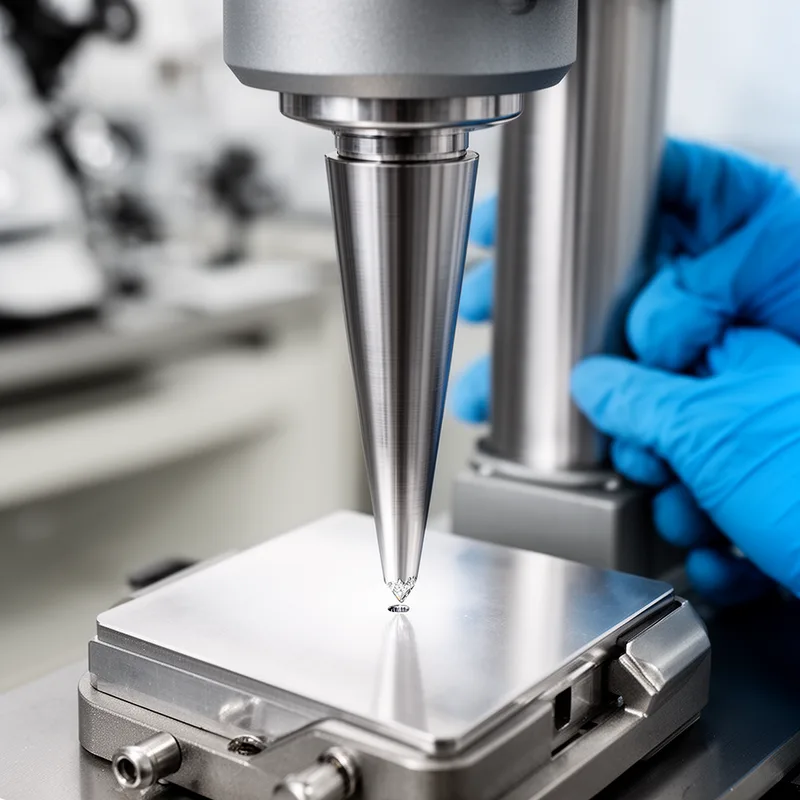
indenter
- noun
- /ɪnˈdɛntər/
- Specialized
- The pressure at the interface between the indenter and the sweat pad was measured for each applied load using one cell of the Oxford Pressure Monitor (Talley Medical Equipment Ltd., Romsey, UK).
- using an indenter
Examples
-
Uniaxial loading was applied via a rigid indenter positioned immediately beneath a loading pan, which was incorporated in a balanced beam counterbalanced at the other end by a moveable weight (Figure 1).
Academic text (1993) -
A 0.25-in (1.22 cm) diameter, flat-faced plunger was used as the indenter in all cases.
Academic text (1995) -
The other indenter created a non-Hertzian profile with large peaks near the contact radius.
Academic text (1994) -
On removal of the indenter, the existing sweat pad on the experimental arm was replaced by a fresh pad located over the test site.
Academic text (1993) -
Results showed an approximately Hertzian surface stress profile for the 3 cm radius of curvature indenter.
Academic text (1994) -
The engineer used a indenter to create a precise indentation in the metal sample for testing hardness.
-
To evaluate the material's hardness, he placed the indenter on the surface and applied pressure until a dent formed.
-
For her experiment, the researcher selected a diamond-tipped indenter to ensure accurate depth measurements in the test material.
How Deep
 1
7.2
1
7.2


- Specialized
33
5.2
- Specialized
- Specialized
3
8.5
Surface Forms
Morphology
Etymology
The word indenter comes from indent, related to dent meaning 'a hollow or mark'. That's why an indenter is a tool that makes a small dent or mark in a material, for example when testing how hard the metal is.