
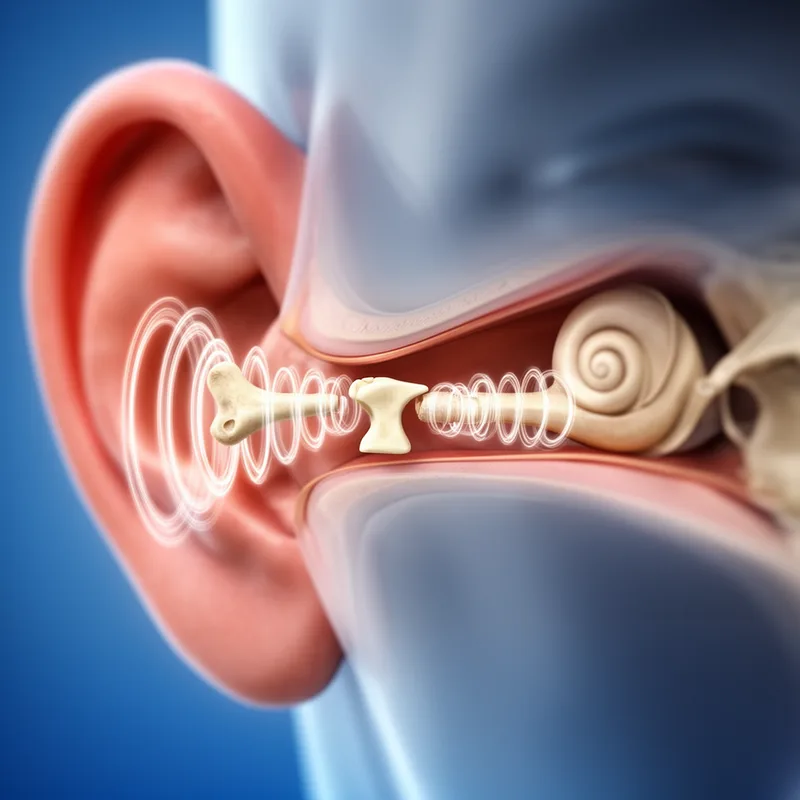
incus
 1
9.9
1
9.9

- noun
- /ˈɪŋkəs/
- Specialized
- When sound waves enter the ear, they cause the incus to move, transferring vibrations to the stapes.
- incus and malleus
- incus and stapes
- body of the incus
Examples
-
This is the malleus, the incus, and the stapes.
-
The malleus, incus, and stapes can be seen to move together, similar to a simple force-increasing lever.
Academic text (1998) -
A slight degree of osteitis was seen in the long process of the incus.
Academic text (2001) -
The basic transducer has been developed with two styles of incus attachment.
Academic text (1998) -
The phase difference between the malleus and the incus also increases from that observed at 1,000 Hz.
Academic text (1998) -
During surgery, the wire is fixed to the long arm of the incus and manually closed with McGee forceps.
Academic text (2005) -
The malleus and incus were fused, but an incudomalleolar joint was seen.
Academic text (2003) -
Also, preservation helps maintain the blood supply to the lenticular part of the incus, which may reduce postoperative incus necrosis.
Academic text (1999) -
A stainless-steel stapes prosthesis was then placed from the incus to the footplate.
Academic text (2006) -
The ossicular chain reconstruction involved placing the resculpted incus body between the long process of the malleus and the stapes capitulum.
Academic text (2005)
Synonyms

 1
7.7
1
7.7
A small bone in the middle ear that passes sound from one ear bone to another
Surface Forms
Etymology
Incus comes from the Latin word incus, meaning 'anvil'. The bone is shaped like a tiny anvil, so it was named that way and this helps you remember that it passes sound vibrations through the middle ear.