

imitative
- adjective
- /ˈɪmɪˌteɪtɪv/
- Specialized
- Children often enjoy imitative games where they mimic animal sounds, like barking or meowing.
Examples
-
The voice, imitative, toneless, and mechanical, testified to as much.
Fiction book (1994) -
They chose to because that was the way the culture that developed scrivening tended to think about things: mechanistically, orderly, imitative (of the gods).
Blog text (29) -
As a live performance instrument, the workstation can produce—in addition to "traditional" synthesizer sounds—imitative sounds in situations where acoustic instruments are not available.
Academic text (1992) -
From the Greek for "word making," the term refers broadly to some fitness between a word's sound and definition, and in rendering onomatopes, Ruscha again calls attention to those instances of semantic opacity when verbal sound is imitative of meaning, or when ties between the two collapse.
Academic text (2005) -
The word 'buzz' is an imitative expression of the sound a bee makes.
-
Onomatopoeic words, such as 'clang' and 'whisper,' are considered imitative because they replicate the sounds they describe.
Synonyms



 1
7.4
1
7.4
A word that sounds like the noise something makes, for example bang or buzz

A word that copies the sound something makes, like 'buzz' or 'bang'
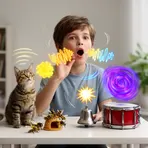
Words that copy sounds like 'meow' or 'buzz'

A word that copies a natural sound, for example buzz or hiss
Compounds

- Specialized
To send fake radar or radio signals into enemy systems to trick them

- Specialized
To send fake radio signals that look real to trick enemy electronic systems
How Onomatopoeic
- Specialized
1
7.4

- Specialized
Surface Forms
Morphology
Etymology
Imitative also describes words that copy natural sounds and comes from the same root as imitate, meaning 'to copy'. So an imitative word like 'buzz' or 'bang' is made to sound like the thing it names.