
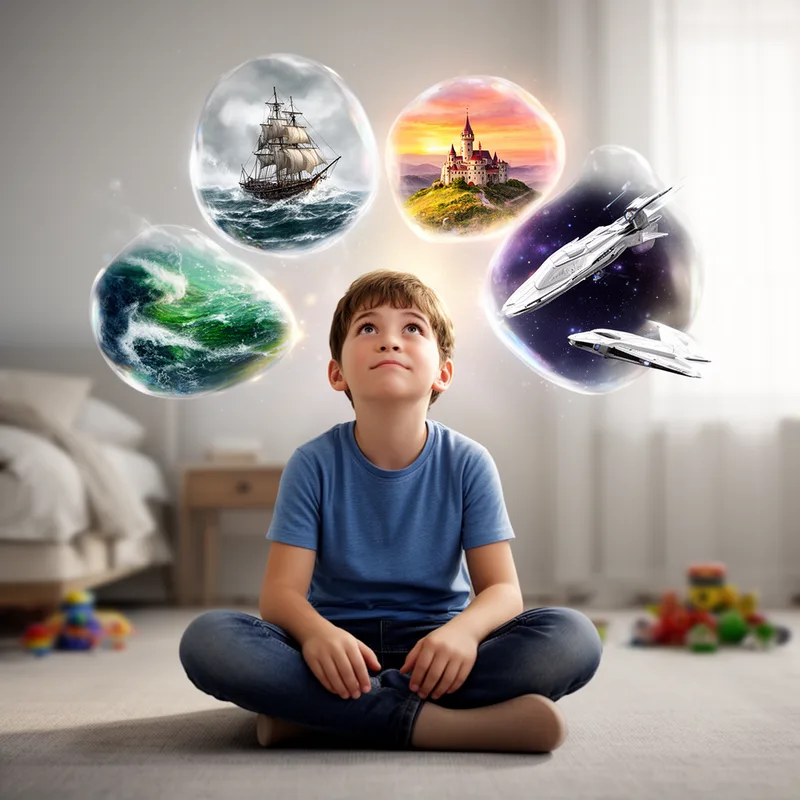
imaginational
- adjective
- /ɪˌmædʒɪˈneɪʃənl/
- According to Piechowski, Dabrowski emphasized intellectual, emotional, and imaginational OEs, viewing them as necessary for personal growth characterized by moral questioning, existential concerns, and self-judgment.
- imaginational overexcitabilities
- imaginational and psychomotor
- Emotional, imaginational
Examples
-
Qualitative analysis provided some support for imaginational and sensual intensities, with participants able to provide examples of ways in which imagination, fantasy, and sensuality enriched their lives.
Academic text (1992) -
Emotional, imaginational, and psychomotor intensities and critical attitudes appear, for the most part, unrelated to measures of intelligence and creativity.
Academic text (1990) -
Of particular relevance for this discussion are the psychomotor and imaginational overexcitabilities.
Academic text (2003) -
Factor II, Imaginational Intensity, is composed of items describing active fantasy life, sensitivity to separation, and nonconformity.
Academic text (1990) -
Artists demonstrate stronger overexcitabilities, especially imaginational and emotional, than intellectually gifted adults in all areas except intellectual.
Academic text (1992) -
Creativity measures assess creative production within the task situation; characteristics such as imaginational intensity suggest covert rather than overt creative behavior.
Academic text (1990) -
The gifted child expressing imaginational overexcitability through daydreaming may look inattentive, but could be using this uninterrupted time to think creatively (Cramond, 1994).
Academic text (2003) -
Children often show imaginational skills when they invent fantastical stories during play.
-
The artist's imaginational approach to painting allows viewers to explore new worlds and ideas.
-
In class, her imaginational thinking helped her develop innovative solutions to complex problems.
Synonyms

 60
3.7
60
3.7

Having many new and different ideas
 21
8.0
21
8.0
Very strange and like something made up in dreams or stories
 12
6.0
12
6.0
Imaginative but not true or practical


 1
8.6
1
8.6
Relating to ideas or thoughts

Imaginative in a way that is not practical
Surface Forms
Morphology
imaginational = imagination (transparent) = imagin + ation + al
The adjective is a regular derivation from 'imagination' with the suffix '-al', so the meaning 'relating to imagination' is directly recoverable.
Etymology
Imaginational comes from the common verb imagine, which means 'to form a picture in your mind' and is related to the word image meaning 'picture'. So, imaginational describes things that use or belong to your imagination, like play or thinking that makes mental pictures.