

imaginary place
- noun
- /ɪˈmædʒɪˌnɛri pleɪs/
- Literature
- Youth enjoy exploring pictorial maps of both real and imaginary places.
Examples
-
BOOKS, MAPS, AND IMAGINARY PLACES
Academic text (2014) -
Maps of Imaginary Places as Invitations to Reading
Academic text (2014) -
The village was an imaginary place really.
-
During a short warm-up exercise, students used images to think about an imaginary place.
Academic text (1994) -
No one gets my permission to go to heaven because I don't waste time considering who gets to go to an imaginary place.
Blog text (23) -
Rather than allow us listeners to identify with the music, we are invited to travel with it to that imaginary place where meaning is unclear, rules are nonexistent, and where culture and language are flexible.
Academic text (2014) -
Tim would roll over, hoping to find his way back to sleep, to the imaginary place where his wife, Kari, would not be waiting at home alone, trusting him to be faithful.
Fiction book (2002) -
For high-quality commercial software to create worlds, cities, and other types of imaginary places, try Pro Fantasy Software (https://secure.profantasy.com/).
Academic text (2014) -
As a child, I often retreated to an imaginary place filled with adventure and magic.
-
In her stories, she describes an imaginary place where dreams come true and anything is possible.
Synonyms

 21
4.4
21
4.4

An imagined place in your mind with magic and strange creatures
 7
5.5
7
5.5
A beautiful imaginary place in stories where small magical creatures live
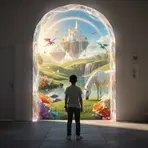 3
6.1
3
6.1
An imaginary place where everything is perfect and magical
 2
8.8
2
8.8
A made-up perfect place that exists only in dreams
 2
6.6
2
6.6
An imagined perfect place that exists only in dreams


 1
6.9
1
6.9
A place that exists only in stories or imagination

A place that exists only in the mind or in stories
How Real

Surface Forms
Morphology
The noun phrase combines the transparent adjective 'imaginary' (not real) with 'place' (location), so the meaning 'a place that exists only in the imagination' is directly derivable from its parts. This simple adjective+noun composition is a common, cross‑linguistic pattern and should be immediately understandable to a B1 learner who knows both constituents.
Etymology
The phrase imaginary place comes from the picture of a child or writer drawing a map to a land that exists only in their head. The word imaginary means 'not real' and place means 'a location', so the phrase is used for 'a place that exists only in the imagination'.