
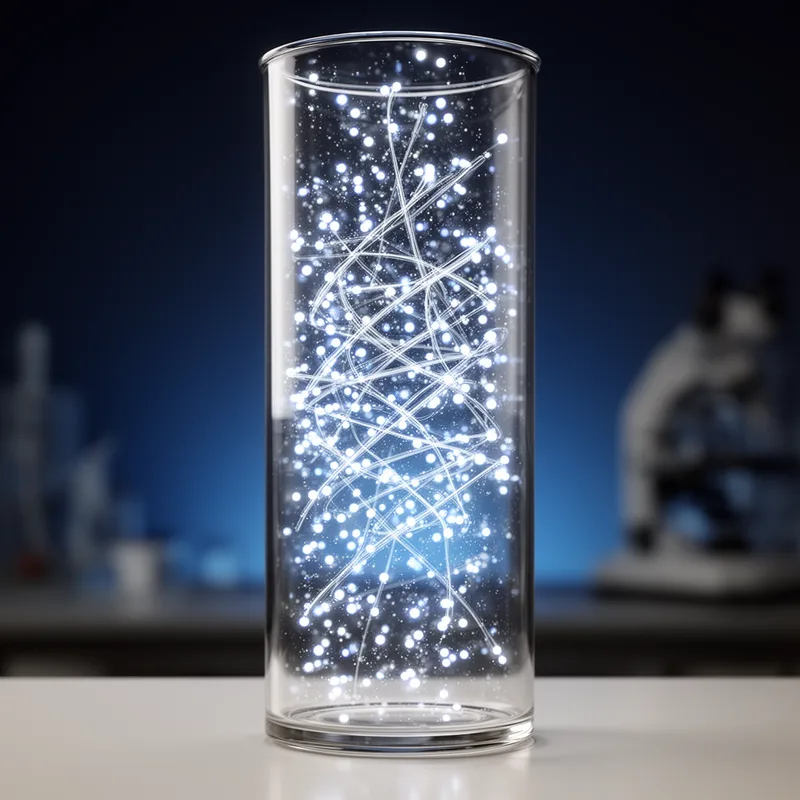
ideal gas
 1
4.4
1
4.4

- noun
- /aɪˈdil ɡæs/
- Specialized
- Under certain conditions, many gases can approximate the behavior of an ideal gas in scientific calculations.
Examples
-
The ideal gas law PV=nRT describes how temperature, pressure, and volume relate in an ideal gas.
-
The ideal gas law PV=nRT tells us that with increasing pressure, the temperature of the gas will rise.
Blog text (18) -
I get the energy of the ideal gas at temperature beta.
-
This formula is more general than just the ideal gas or an approximately ideal gas.
-
These laws, like the ideal gas law, are restrictions on state variables.
Academic text (2005) -
Fill this tube with some amount of an ideal gas at 0 K.
Blog text (18) -
The ideal gas law says that when a gas is compressed, its temperature rises.
Blog text (18) -
You're assuming that CO2 can be treated as an ideal gas.
Blog text (32) -
They were expected to behave like ideal gases, which are easily compressed.
Academic text (1993) -
In 1916, when he began trying to understand the physics of the pulsating stars known as Cepheid variables, there were really no models of stars and only a few very simple models of ideal gas balls held together by gravity.
Academic text (1993)
Synonyms

An imagined gas whose particles have no size and do not attract each other, used in physics
Surface Forms
Morphology
A B1 learner who knows 'ideal' (perfect/theoretical) and 'gas' can infer that an 'ideal gas' is a perfect or simplified kind of gas, so the general notion is compositionally clear. However, the precise technical assumptions (point-like molecules, no interactions) are specialist knowledge and not directly derivable from the constituents, so the expression is only partially transparent.
Etymology
The noun ideal gas comes from a simple image: imagine a gas of tiny particles that do not take up space and never touch, a 'perfect' gas. Scientists call this simple idea an ideal gas, so the term means a simple 'model' used to make calculations about real gases.