
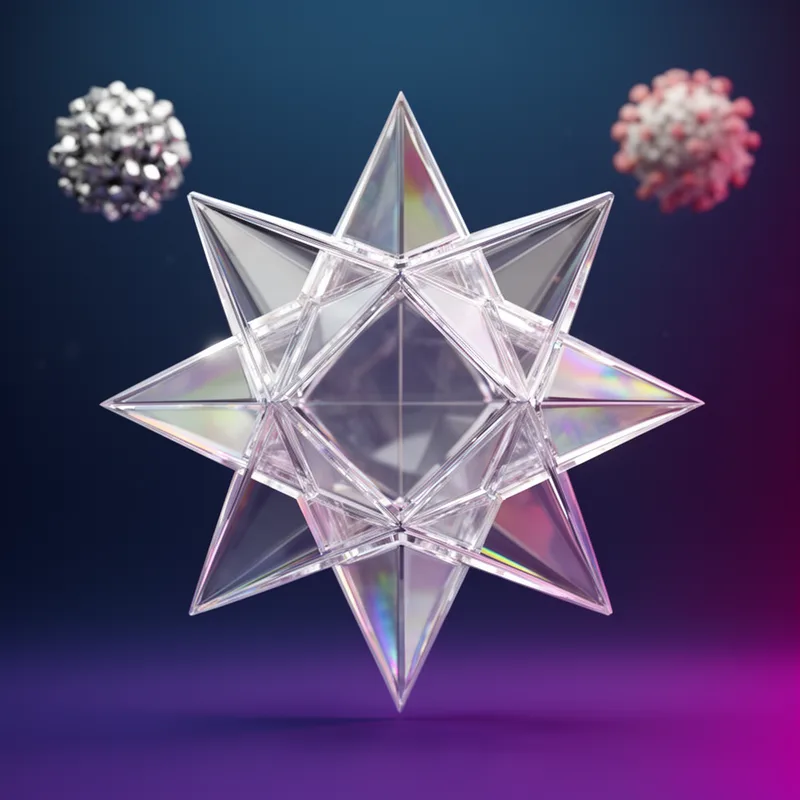
icosahedral


 1
9.9
- adjective
- /ˌaɪkəˈseɪdrəl/
- Specialized
- Better data revealed that spherical capsids overwhelmingly choose icosahedral symmetry.
- icosahedral structure
Examples
-
The atoms are arranged in an icosahedral structure for some size ranges and in more closely packed structures typical of bulk metals at other sizes.
Academic text (1993) -
The propensity for forming the icosahedral structure is greater in the nickel clusters, consistent with the decrease in d-electron bonding in nickel relative to cobalt.
Academic text (1993) -
Just explain how Thales, about six hundred years BC, found that water was icosahedral.
Blog text (5) -
If icosahedral structures maximize the volume enclosed by a shell of identical units, is it any wonder viruses choose it?
Academic text (2004) -
In the structure of SV40, the principles of quasi-equivalence in icosahedral construction have been taken to a new level of elegant complication.
Academic text (1995) -
The minima are more numerous and don't necessarily correspond to Caspar and Klug's sequence of icosahedral structures.
Academic text (2004) -
In 1962, Donald Caspar and Aaron Klug devised a mathematical rule for generating icosahedral capsid structures.
Academic text (2004) -
Electron microscopy of infected cells demonstrated icosahedral, nonenveloped viral particles characteristic of MRVs (Figure 1).
Academic text (2013) -
The family Reoviridae is a diverse group of viruses with double-stranded RNA genomes contained within icosahedral, nonenveloped, double-layered protein capsids (1).
Academic text (2013) -
The soccer ball has an icosahedral shape, making it easy to kick and pass.
Surface Forms
Morphology
icosahedral = icosahedron (semi-transparent) = icosa + hedr + al
The adjective is formed regularly from the technical noun 'icosahedron' with the suffix '-al', but the base term itself is specialized.
Etymology
The word icosahedral comes from Greek parts icosa- 'twenty' and -hedron 'face'. So an icosahedral object is one that has twenty faces, like a triangle has three sides.